A family fishing bag works when it is organised by person rather than by tackle type, because four anglers sharing one compartment spend the day sorting other people's gear. The setup that holds up is a 50 to 70 litre bag with four colour-coded zones, one per angler, plus a shared safety and refreshment compartment that one adult owns outright. Loaded for a family of four it weighs 12 to 18 kilograms, which means it should be carried by an adult with a hip belt or moved on a cart, never by a child. Hooks go in lidded boxes, blades stay with an adult, and life jackets are worn rather than packed. Programme buyers should plan on 500 pieces per design and colour, six to ten working days for a sample, and thirty-five to fifty days for bulk.
How Much Kit Three or Four Anglers Need
The instinct on a family trip is to pack four of everything, and the arithmetic says otherwise. Terminal tackle, tools, pliers, nets and first aid are shared; only the consumables and the rods are per-person. Four anglers need four rods, four small tackle selections, one tool set, one net and one first aid kit, and the saving over four complete kits is roughly 40 percent of the weight.
| Item | Per angler or shared | Count for four | Weight |
|---|---|---|---|
| Rod and reel combos | Per angler | 4 | 2000 to 3200 g |
| Small tackle selection | Per angler | 4 x 300 g | 1000 to 1400 g |
| Pliers, disgorger, scissors | Shared | 1 set | 600 to 900 g |
| Landing net | Shared | 1 to 2 | 700 to 1200 g |
| First aid and sun care | Shared | 1 kit | 400 to 700 g |
| Water and snacks | Shared | 3 to 4 litres | 3200 to 4500 g |
| Rain layers | Per angler | 4 | 1200 to 2000 g |
That comes to 9 to 14 kilograms before the bag itself, and 12 to 18 kilograms with a 60 litre bag included. The number matters because it decides who carries: at that weight, an adult with a proper hip belt is fine for a kilometre, and a child is not, which is why the load has to be split deliberately rather than handed to whoever is least busy.
Zoning One Bag by Person Instead of by Type
Zoning by tackle type is how adult bags are built and it fails with a family, because hooks, lures and weights from four people end up in one shared cavity within twenty minutes. Zoning by person is the fix: each angler gets a colour, each colour gets a pouch or a compartment, and the rule is that nothing crosses a colour boundary. Kids accept this remarkably well because it makes ownership explicit.
| Zone | Contents | Owner | Colour role |
|---|---|---|---|
| Zone 1, adult A | Tools, pliers, first aid, licence | Adult A | Red |
| Zone 2, adult B | Shared tackle, spare line, weights | Adult B | Blue |
| Zone 3, child A | Child tackle, small hooks, bobbers | Child A | Yellow |
| Zone 4, child B | Child tackle, snacks, small net | Child B | Green |
| Shared compartment | Water, rain layers, wipes, rubbish bag | Adult A | Neutral |
Colour should be visible from outside the bag rather than discovered on opening it, so coloured zip pulls, coloured pouches or a coloured patch on each compartment all work and cost almost nothing. The test of a good zoning scheme is whether a six year old can find their own hooks without asking, and a colour system passes that test where a labelled one usually does not. Where the budget stretches to it, four removable pouches in four colours are better still, because a pouch can be handed to a child at the start of the session and returned at the end without the bag ever being opened.
Kids Rods, Short Rods and Where They Go
Children's rods are shorter and lighter, typically 1.2 to 1.8 metres against an adult 2.1 to 2.7 metres, and that difference matters for carry because short rods are easier to transport made up and more likely to be broken if they are not. A made-up rod carried horizontally catches on everything; the same rod carried vertically in a holder does not.
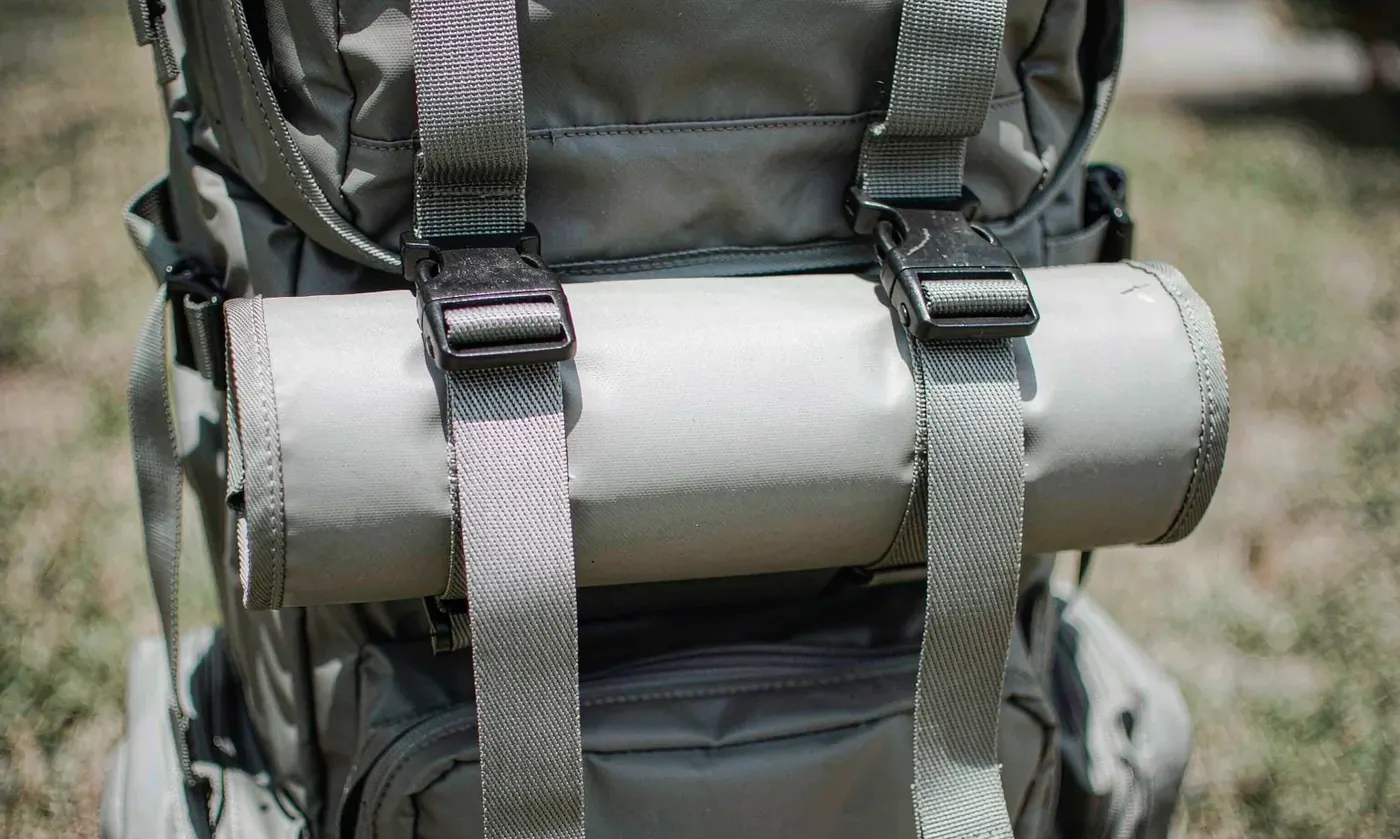
Two rod holders on the outside of the family bag, angled ten to fifteen degrees off vertical, carry the two shortest rods and leave both adult hands free. Longer adult rods should travel in a sleeve or be carried separately, because a 2.4 metre rod strapped to a loaded 60 litre bag becomes a lever that pulls the carrier off balance on uneven ground.
- Children's rods of 1.2 to 1.8 metres can be carried made up in vertical holders; adult rods usually cannot.
- Keep reels on children's rods covered during transport, since a bent spool lip ruins the line and the session.
- Tape or sleeve the rod tips together so they cannot tangle with each other while being carried.
- Give each child responsibility for one rod, because ownership reduces the number of rods left on the bank.
- Carry one spare spool of line for every two rods, since family sessions lose more line than adult sessions.
Hooks, Blades and the Rules for a Shared Bag
A shared bag with children in the group needs explicit rules about sharp objects, and they should be physical rules rather than verbal ones. Every hook goes in a lidded box, never loose. Blades stay in one adult zone and are never in a child-accessible pocket. And pliers are returned to a sheath rather than put down, because a hook on the ground is the single most common injury on a family session.
The statistics justify the strictness. Hook injuries are the most frequent fishing injury treated in emergency departments, and a high proportion involve a second person rather than the angler, usually during unhooking or while moving gear. Two habits remove most of the risk: pinch or remove the barb on hooks used by children, and keep a pair of side cutters in the adult zone so a deeply set hook can be cut and pushed through rather than pulled.
First aid belongs in the same compartment as the cutters, and it should include tweezers, antiseptic wipes, plasters and a triangular bandage. Guidance on wound care and tetanus boosters is published by the United States Centers for Disease Control and Prevention, and a booster that is more than ten years old should be renewed before the trip rather than after the injury.
Water, Snacks and Sun: The Volume Nobody Plans For
Family trips fail on refreshment more often than on tackle. Children drink more per kilogram of body weight than adults, they notice hunger earlier, and neither is improved by being told to wait. A family of four on a four hour session in warm weather needs 3 to 4 litres of water and two rounds of snacks, which is 3.2 to 4.5 kilograms of the total load and the largest single group in the bag.
| Group | Per person per four hours | For four people | Weight |
|---|---|---|---|
| Water, cool weather | 500 ml | 2 litres | 2100 g |
| Water, warm weather | 800 to 1000 ml | 3.2 to 4 litres | 3400 to 4200 g |
| Snacks, two rounds | 150 to 250 g | 600 to 1000 g | 700 to 1100 g |
| Sun cream, SPF 30 plus | 30 ml applied twice | 120 ml | 150 g |
| Hats and sunglasses | One each | 4 sets | 250 to 400 g |
Packing order follows from the weight: water goes low and central in the bag, because it is dense and stable, and snacks go in a compartment that can be opened without unpacking anything else. A bottle left in a side pocket of a bag that is set down on a slope rolls into the water within the first hour, which is the argument for internal sleeves.
Life Jackets: Worn, Not Packed
On a family trip near open water, a life jacket that is packed is a life jacket that is not being worn at the moment it is needed. Children should wear a properly fitted jacket for the whole session when fishing from a pier, a boat, a jetty or any bank with a steep drop, and the jacket should be checked for fit at the start of the season rather than assumed to fit.
Fit is measured in two numbers. The jacket should be rated for the wearer's weight, and it should not ride up past the chin or ears when the wearer is lifted by the shoulders. A jacket that rides up is too large regardless of what the label says. Requirements for carriage, approval markings and child sizing are published by the United States Coast Guard Boating Safety Division, and they should be checked against the jackets actually being used. Jackets should also be dried fully before storage, because a jacket put away damp loses buoyancy foam integrity over a season and mildews within weeks.
Who Carries What on a Family Trip
The load should be assigned before leaving the car, not negotiated on the path. A workable split for a family of four puts the big bag on the adult with the strongest carry, gives each child a small sling or shoulder bag with their own water and snacks at 1 to 2 kilograms, and gives the second adult the rods, the net and the jackets. That puts roughly 60 percent of the total on one adult and 10 to 15 percent on each child.
- Children should carry no more than about 10 percent of their body weight, which is 2 kilograms for a 20 kilogram child.
- Each child carries their own water, so nobody has to unpack the big bag to hand out a drink.
- Rods go with an adult, because a child carrying a made-up rod on rough ground will trip.
- Jackets go with an adult and are worn before reaching the water, not after.
- The first aid compartment is one adult's responsibility and never moves between bags.
Rain: The Family Day That Runs Long
Adult sessions end when the weather turns; family sessions often do not, because the car is twenty minutes away and the children are mid-session. That makes rain protection more important on a family trip than on any other, and it changes the requirement from a shower-resistant shell to something that keeps four sets of clothing dry for an hour.
Two solutions stack well. A bag with an IPX5 or better shell plus its own rain cover protects the contents, and a separate dry bag of 15 to 20 litres holds the four rain layers until they are needed. A wet jacket packed with dry clothing produces four cold children in twenty minutes, which is the fastest way to end a trip that was going well.
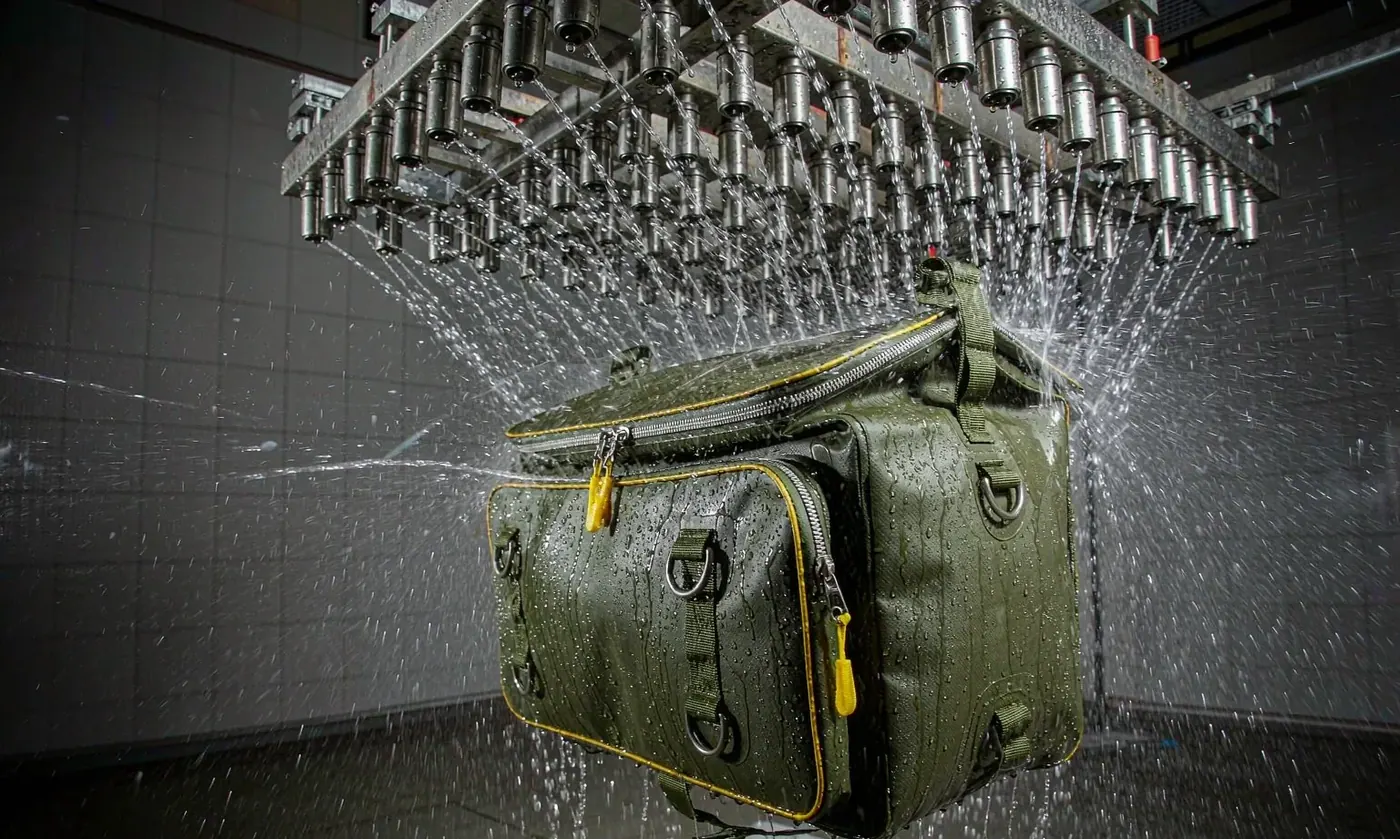
Ratings are explained in the IPX rating guide, cover options are compared in the fishing bag rain cover review, and the enclosure test method is published by the International Electrotechnical Commission.
The Two-Bag Alternative
One large bag is not always the right answer, and it is worth stating where the alternative wins. For a family with a long walk or with two children under eight, two medium bags of 30 to 40 litres are better than one large one: the load splits between two adults, each child still has their own zone, and if one bag is set down nothing critical is lost.
The split should be by function rather than by person. One bag carries tackle, tools and safety; the other carries water, food, clothing and comfort. That way the bag most likely to be opened repeatedly, the refreshment bag, is the one that does not contain hooks. It also means the bag set down nearest to the children is the safe one, which matters when four people share a small bank. Large single-bag options are reviewed in the best large tackle backpack guide, and open-top formats that suit shared access on the fishing tackle tote page.
Attention Span: Timing the Family Session
Family sessions are limited by attention rather than by fish, and the bag can either support a good exit or make it chaotic. Young children fish well for 45 to 90 minutes and then stop, and the difference between a good day and a bad one is usually whether the adults recognised that point or pushed past it. Practical planning means the bag should be packable in under five minutes so the exit happens when it should rather than twenty minutes later.
Three things make the exit fast. Keep everything in its zone so there is no sorting at the end. Keep a rubbish bag in the shared compartment, because a family session generates more waste than an adult one and leaving it is not acceptable. And keep the rods sleeved or holder-ready so they can be picked up and carried without re-rigging.
What Helps a Child Actually Catch Something
A child who catches nothing in three hours is unlikely to ask for a fourth, so the bag should carry the kit that produces early success. That means small hooks in sizes 8 to 12, simple float or bobber rigs, and bait that stays on the hook: bread flake, sweetcorn, worms or dough baits all outperform artificial lures for a first session. It also means a landing net sized small enough for a child to use, since a net that is too heavy is a net that an adult ends up holding.
- Hooks in sizes 8 to 12 with the barb pinched, which removes the hardest part of unhooking.
- Two or three float rigs pre-tied, because a child will lose or tangle the first one within ten minutes.
- Bait that stays on the hook: bread flake, sweetcorn, worms or dough, not lures that need skill to work.
- A small net of 40 to 50 centimetres handle length, light enough for a child to lift with a fish in it.
- A towel and a bag for wet hands, since the sensory part of fishing is what children remember most.
One more detail changes the whole day: bring a second adult or accept that the first adult will not fish. A child landing a fish needs two hands and one helper, and a parent trying to fish at the same time produces tangles, lost fish and frustration on both sides. The bag should therefore hold one adult kit and one teaching kit rather than two adult kits.
Cleaning Up After Four People
A family bag gets dirtier and damper than an adult bag because more hands touch it and more food passes through it. The end-of-day routine is the same three steps with one addition: empty every pocket, brush out crumbs before they absorb moisture, rinse the shell, and dry open for at least twelve hours. The addition is a monthly check of the child zones for food residue, which is what attracts insects and rodents into stored gear.
Drying matters more with a family bag because it is more likely to be put away closed and damp at the end of a tiring day. Standing it open in a garage overnight costs nothing and prevents the mould that appears within a week. Drying method is in the drying a wet fishing bag guide, and first-timer kit selection in the first fishing bag guide.
Specification Notes for Programme Buyers
QUANZHOU JUNYUAN BAGS has delivered waterproof bag programmes since 2014, with a founding team in this industry since 2004. Output is 200,000 units a month, verified by SGS, under BSCI and ISO 9001 governance, with materials screened for REACH and California Prop 65 and every bulk order inspected at AQL 2.5. A family-format brief should open with the number of anglers and the assignment scheme, because those decide the compartment count and the colour strategy before any material is chosen.
Then specify the zone layout and colour system, closure type, base construction, rod holder geometry, hardware grade, shell material and coating thickness, colourway and quantity. Any claim relating to children's product safety should reference published requirements and recognised test methods rather than being left as a general assurance. Five hundred pieces per design and colour is the opening order size. Sampling runs six to ten working days, bulk thirty-five to fifty days from approved sample and deposit, and shipping is FOB Xiamen or DDP to upwards of one hundred nations. Briefs go to service@junyuanbags.com.
People Also Ask
How big a bag does a family of four need?
Fifty to seventy litres, zoned by person rather than by tackle type, with a shared compartment for water, food and rain layers.
Should each child have their own tackle compartment?
Yes, colour-coded. Children accept zone ownership well, and it stops four people sorting one shared cavity all day.
How much should a child carry on a fishing trip?
About ten percent of body weight, which is roughly two kilograms for a twenty kilogram child, in their own small bag.
Do kids need life jackets for bank fishing?
They should wear one on a pier, boat, jetty or any bank with a steep drop. A jacket that rides past the chin is too large regardless of the label.
How much water does a family fishing trip need?
Three to four litres for four people over four hours in warm weather, which is the single heaviest group in the bag at up to four kilograms.
Is one big bag or two medium bags better for a family?
Two bags of thirty to forty litres for long walks or young children, split by function: one for tackle and safety, one for food and clothing.
Frequently Asked Questions
Q1. What is the best way to organise a family fishing bag?
By person, not by tackle type. Give each angler a colour-coded zone so nothing crosses boundaries, and keep hooks in lidded boxes.
Q2. How heavy is a family fishing bag?
Twelve to eighteen kilograms for four people including the bag, water and rain layers. That is an adult carry, never a child carry.
Q3. Should children carry their own gear?
Yes, a small bag of one to two kilograms with their own water and snacks, up to about ten percent of their body weight.
Q4. Where should hooks be kept with children around?
In lidded boxes inside an adult-supervised zone, never loose. Barbless or pinched barbs reduce both injury risk and unhooking time.
Q5. How many rods can a family bag carry?
Two short rods made up in vertical holders, plus adult rods in a sleeve or carried separately. Long rods on a loaded bag act as a lever.
Q6. What first aid should a family fishing bag contain?
Tweezers, antiseptic wipes, plasters, a triangular bandage and side cutters for a deeply set hook, all in one adult-owned compartment.
Q7. Do children need life jackets on a pier?
Yes, and they should be worn rather than carried. Check fit by lifting the wearer by the shoulders; the jacket should not ride past the chin.
Q8. How much water should we pack for four people?
Three to four litres for a four hour session in warm weather, carried low and central in the bag because it is the densest item.
Q9. Should a family use one bag or two?
Two bags of thirty to forty litres if the walk is long or the children are under eight, split by function so the most-opened bag has no hooks in it.
Q10. What is the MOQ for a family-format fishing bag programme?
Five hundred pieces per design and colour, with six to ten working days for sampling and thirty-five to fifty days for bulk from approved sample and deposit.