A pier bag has to survive three things at once that no other fishing bag is designed for: a carry of 400 metres to 2 kilometres at the start and end of every trip, sustained wind that tips an unweighted bag over in seconds, and salt spray that reaches everything on the deck. The specification that answers all three is a 40 to 60 litre bag with a wide moulded base, a low centre of gravity, 316 grade or equivalent corrosion-resistant hardware, and an IPX6 rating, carried on a pier cart for loads above 14 kilograms. Bags designed for boat decks fail on piers because they assume a flat, sheltered surface and a short carry. Programme buyers should allow 500 pieces per design and colour, six to ten working days for a sample, and thirty-five to fifty days for bulk.
The Pier Walk Comes First
Every pier trip starts and ends with a walk, and that walk is longer than most anglers admit. A municipal pier of 800 metres means 1.6 kilometres of carrying before fishing begins, plus the same again at the end with wet, heavier gear. At 12 kilograms that is a genuine physical event rather than a stroll, and it decides the bag before any feature does.
The crossover point between carrying and wheeling sits around 14 kilograms. Below that, a well-fitted backpack with a hip belt is comfortable for a kilometre. Above it, a pier cart pays for itself in one season, because the alternative is carrying 18 to 22 kilograms over wet planks with a rod in each hand, which is how shoulders and lower backs get injured.
| Pier walk distance | Comfortable carried load | Suggested carry | Typical total kit |
|---|---|---|---|
| Under 300 m | 16 to 20 kg | Backpack with hip belt | Full pier kit plus two rods |
| 300 to 800 m | 12 to 16 kg | Backpack, or cart if over 16 kg | Two rods, tackle, bait, water |
| 800 m to 1.5 km | 8 to 12 kg | Pier cart strongly advised | Reduced kit, one rod made up |
| Over 1.5 km | Under 8 kg | Pier cart essential | Minimal kit, cart carries the rest |
Wheel choice matters as much as the cart itself on a pier. Planked and concrete surfaces have gaps, expansion joints and debris, so wheels under 100 millimetres in diameter catch constantly and puncture-prone pneumatic tyres are a liability over shell and hook-strewn decking. Solid wheels of 150 to 250 millimetres with sealed bearings are the practical answer, and they should be removable so the cart can be hosed down.
Wind: The Factor That Ruins Most Pier Setups
A pier is a wind tunnel with a hard surface, and the wind does two specific damage types. It tips bags over, and it blows loose items into the water. Both are solved by the same two properties in a bag: a wide base and a low centre of gravity. A bag with a base footprint of at least 300 by 220 millimetres and its heaviest contents in the bottom third resists tipping in wind up to about 45 kilometres per hour; a tall, narrow bag of the same volume goes over at 25.
| Wind speed | What happens on a pier | Bag requirement |
|---|---|---|
| Under 20 km/h | Comfortable, loose paper stays put | Any bag works |
| 20 to 35 km/h | Light items blow, hats and bags tip | Wide base, external straps |
| 35 to 50 km/h | Unweighted bag tips repeatedly | Base footprint over 300 x 220 mm, weight low |
| 50 to 65 km/h | Fishing becomes difficult, spray reaches the deck | Bag anchored or strapped to a rail |
| Above 65 km/h | Most piers close, exposure is dangerous | Do not fish |
Two habits help more than gear. Set the bag down with its back to the wind so the harness and straps act as a windbreak, and put 2 kilograms of the densest item, usually a bucket of bait or water, in the bottom of the bag rather than in an outside pocket. That single change moves the centre of mass down by roughly 80 millimetres and turns a bag that tips constantly into one that stays put.
Wind also carries salt. At 40 kilometres per hour over open water, spray travels the full length of a pier and deposits a fine salt film on everything, including the inside of bags that have been opened once. This is the mechanism behind most pier gear corrosion, and it is why a pier bag should be treated as saltwater equipment even when the fishing itself is estuarine.
Salt Spray and What It Does to a Bag
Salt does its damage in a sequence that takes about three weeks to become visible. Chloride deposits sit on hardware, draw moisture from the air because they are hygroscopic, and start corrosion under the plating of any zinc or nickel coated fitting. The first sign is usually a stiff zip at around 80 hours of exposure, followed by white bloom on buckles and, eventually, structural failure of the smallest, most loaded component.
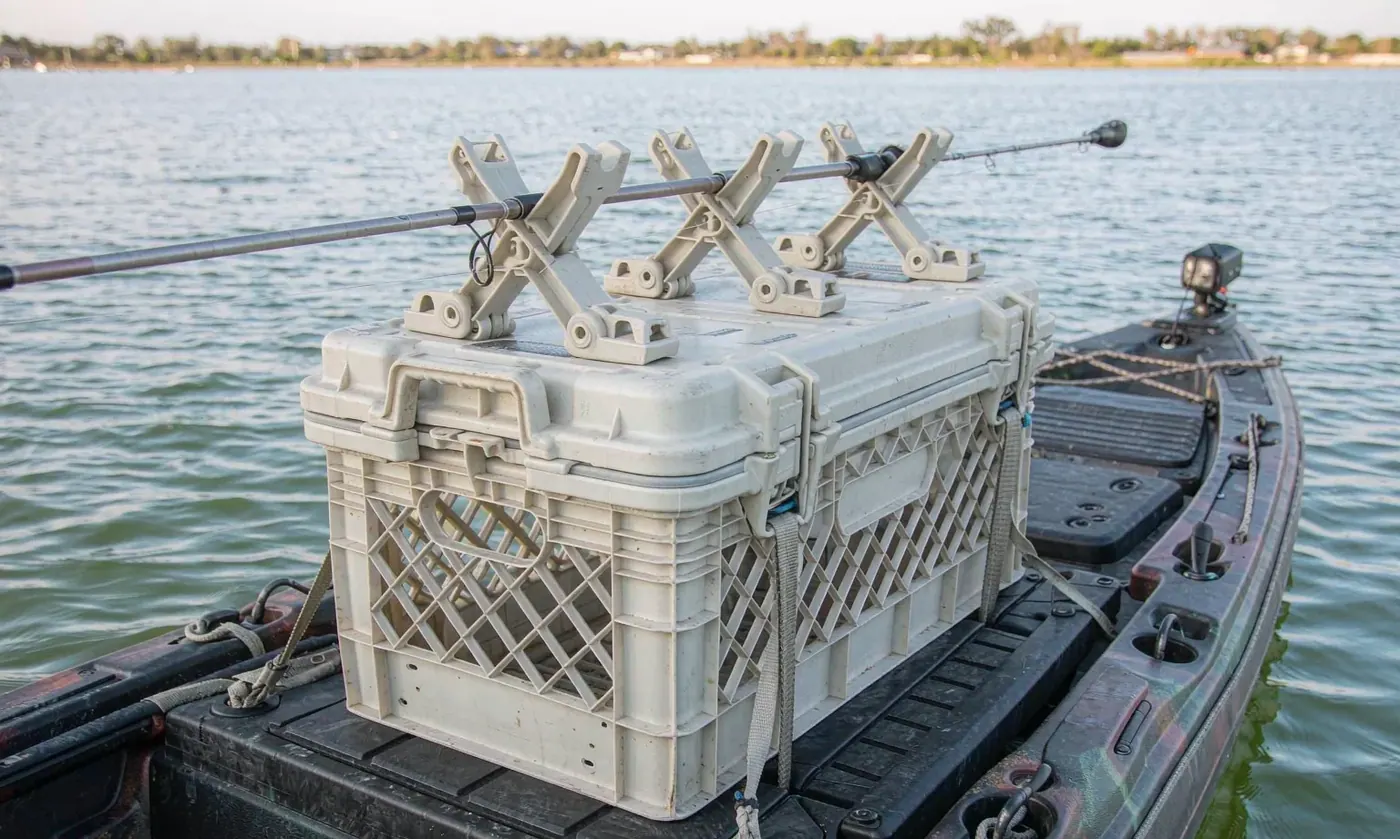
Against that, three specifications earn their cost on a pier bag. Hardware in 316 stainless or a marine-grade polymer avoids the problem at source. A coated or inherently corrosion-resistant zip chain, rinsed with fresh water after each trip, lasts several seasons rather than one. And a smooth shell with fewer external seams gives salt fewer places to sit and crystallise.
- Rinse the whole bag with fresh water at low pressure within four hours of leaving the pier.
- Work the zip under running water so salt is flushed from between the teeth, not just off the surface.
- Dry open and upside down for at least twelve hours, since chloride needs moisture to keep corroding.
- Never store a pier bag closed and damp, which is the fastest route to seized hardware.
- Replace any fitting showing pitting rather than surface bloom, because pitting is structural.
Anyone comparing material and hardware options will find the detail in the corrosion-proof hardware guide, and the wider category on the saltwater fishing bag page.
Bait on a Pier: Live, Cut and Frozen
Pier bait is usually live or frozen and both are awkward to carry. Live bait needs aeration and volume: a bait bucket holding 8 to 12 litres of seawater weighs 8 to 12 kilograms alone, and an aerator pump running on two D cells gives six to ten hours of life. That is the single heaviest item in most pier kits and it is the reason pier anglers use carts.
Frozen bait is easier but needs insulation for the walk out, because a 2 kilogram block of frozen squid thawed by sun and wind on a 1.2 kilometre pier walk arrives as a wet mess. An insulated compartment of at least 10 litres with 8 to 10 millimetres of closed-cell foam holds a 2 kilogram block frozen for four to five hours in summer, which covers most sessions.
| Bait type | Volume or weight | Carry requirement | Season limit |
|---|---|---|---|
| Live bait in seawater | 8 to 12 litres, 8 to 12 kg | Bucket with aerator, cart advised | Six to ten hours of aeration |
| Frozen block bait | 1 to 3 kg | Insulated compartment, 10 litres | Four to five hours frozen in summer |
| Cut bait from the catch | Under 1 kg | Sealed container in a wet pocket | Same day only |
| Sandworms or bloodworms | 100 to 300 g | Insulated pouch with a cold pack | Eight to twelve hours |
Keeping the Bag Where You Put It
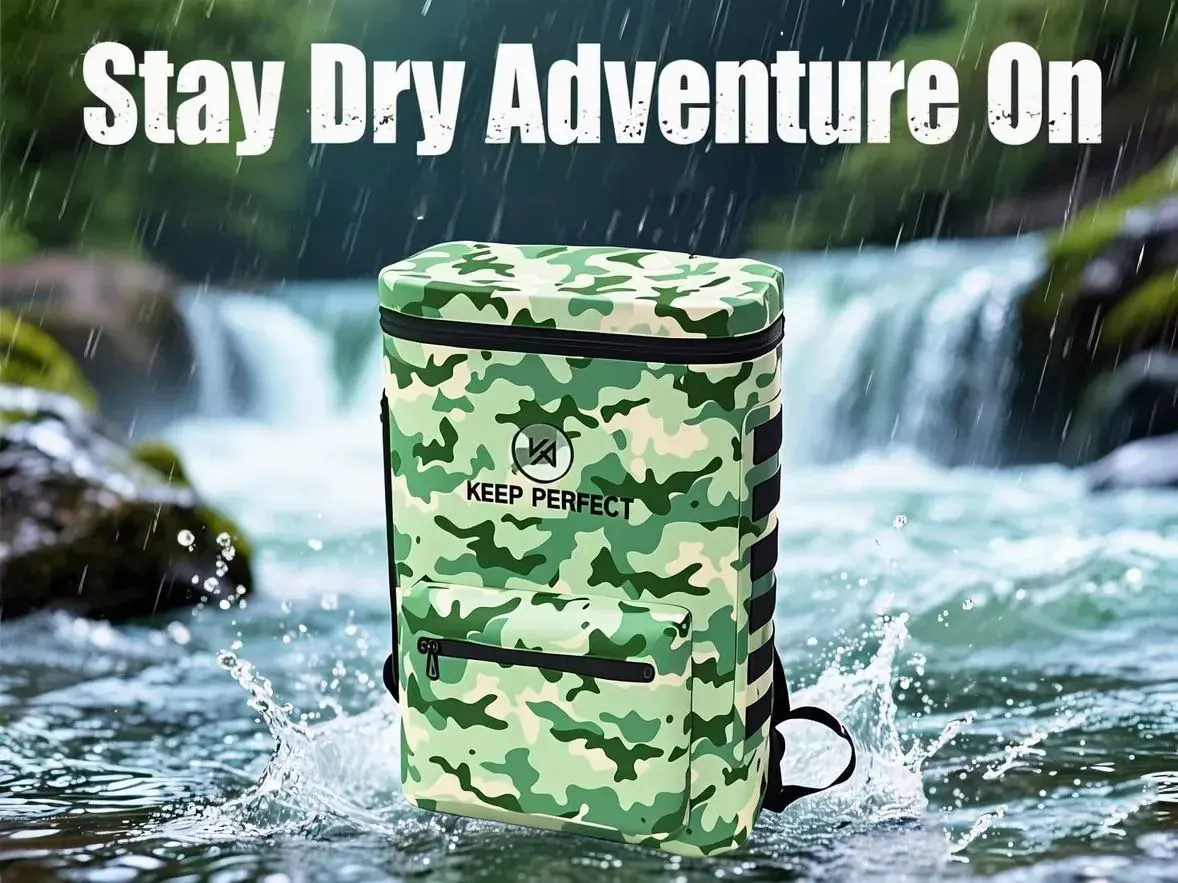
Pier decking is smooth, sloped for drainage and often wet, and a bag set down on it slides. A base with a textured moulded surface and at least four contact points grips where a flat fabric base slides, and the difference is most obvious on the concrete ramps at the ends of a pier where the slope runs to five degrees.
Anchoring is the pier-specific solution worth specifying. Two webbing loops at the base corners, sized for a carabiner, let the bag be clipped to a rail, a bench leg or the pier cart itself, which removes tipping and sliding in one step. Bags with a rail hook or a folding hook sewn into the harness are even better, because a bag hung on a rail stays dry, out of the spray and off the deck entirely.
Rod and Bucket Management at the Rail
Space on a pier rail is contested and a pier angler typically works two rods plus a bucket in an area a metre wide. The bag should therefore be small in footprint and tall rather than wide, and it should offer somewhere to put rods upright without them leaning on the rail where a passing angler will knock them.
- Two rod holders or sleeves on the outside of the bag, set at 10 to 15 degrees off vertical so rods lean back rather than forward.
- A bucket loop or cradle on the base, since a 10 litre bait bucket carried in one hand leaves no hand free for the net.
- A rail hook rated to at least 15 kilograms, because a hung loaded bag plus rods applies a real moment on the hook.
- A flat external pocket for a knife and baiting needle, kept sheathed for safety in a crowded space.
- A small tray or fold-down surface for hooks and weights, since there is nowhere clean to put them down on a pier.
The discipline of pier fishing also means the bag should close quickly and completely. An open bag on a windy deck sheds contents, and a bag that takes twenty seconds to close will eventually be left open at the wrong moment. A single-action closure that seals in under five seconds is worth more on a pier than any interior organisation feature.
Waterproof Ratings for Spray and Wash
A pier bag needs IPX6 rather than IPX5, and the difference is not marketing. IPX6 under IEC 60529 means resistance to powerful water jets from any direction, which is what spray driven at 40 kilometres per hour actually resembles; IPX5 covers only low-pressure jets. Neither rating means the bag can be submerged, and a bag dropped off a pier should not be assumed to protect its contents.
Closure type decides whether the rating is real. A roll-top mouth with three folds and a side-release buckle holds IPX6 comfortably. A coated water-resistant zip holds it for the first season and then needs maintenance. A standard zip under a storm flap does not hold it at all. Ratings are explained in the IPX rating guide, the gap between genuine and nominal waterproofing in the waterproof versus water-resistant comparison, and the test method itself by the International Electrotechnical Commission.
Tides, Swell and Deck Wash
The exposure a pier bag faces is not constant; it follows the tide and the swell. On a low pier with a swell running, spray and occasional green water come over the deck on a cycle of a few minutes, and the bag will be soaked several times in an hour regardless of its rating. On a high pier in calm conditions, the same bag might stay dry all day. Planning around that cycle is more effective than buying a higher rating.
Three practical rules follow. Set the bag on the landward side of the rail rather than the seaward side, which removes most of the spray at no cost. Raise it off the deck by hanging it from a rail hook or resting it on a bench, because deck wash travels along the deck rather than through the air. And check the tide and swell before committing to a spot, using published tide and marine forecasts, since a rising tide plus an onshore wind is the combination that soaks everything.
The rating still matters, but for a different reason than most anglers assume. What saves the contents is not the shell surviving a drenching, since a good shell always does, but the bag being closed at the moment it happens. That is the argument for a closure that seals in under five seconds.
The Pier Kit Checklist
A pier kit is unusually predictable, which makes a checklist worthwhile. It has to cover two rods, bait, terminal tackle, fish care, water, weather protection and safety, and it rarely exceeds 14 kilograms if the bait bucket rides on the cart rather than in the bag.
| Group | Items | Weight | Notes |
|---|---|---|---|
| Terminal tackle | Hooks 1/0 to 6/0, sinkers 30 to 200 g, swivels | 900 to 1400 g | Sinkers dominate the weight |
| Rig and trace material | Two spools, 20 and 40 lb | 200 to 300 g | Keep dry or it degrades |
| Tools | Pliers, disgorger, knife, baiting needle | 700 to 1000 g | All sheathed, all tethered |
| Fish care | Tape measure, glove, bucket rope | 400 to 700 g | A landing net is often pier-shared |
| Water and food | 1.5 litres, sealed food | 1700 to 2100 g | Weight low in the bag |
| Weather layer | Windproof shell, 300 g | 300 to 500 g | Strapped externally until needed |
That checklist totals 4.2 to 6.0 kilograms before bait and rods, which means the bag alone is manageable on a long pier and the cart is really carrying the bait bucket and the rods. Recognising that split is what lets pier anglers leave the 20 kilogram cart at home on short sessions.
Cleaning Salt Off After Every Trip
The post-trip routine for a pier bag is short and non-negotiable: rinse within four hours, dry open for twelve, and inspect hardware monthly. Rinsing should be at low pressure with fresh water, working every zip and buckle, because a high-pressure jet drives salt deeper into stitched seams rather than removing it.
Drying should never be skipped in favour of storage. A bag put away with chloride still on its hardware will corrode in a cupboard just as fast as on the pier, and more insidiously, because nobody sees it until the zip seizes. Full method is in the saltwater bag cleaning guide, and drying technique in the drying a wet fishing bag walkthrough.
Choosing a Pier Bag With or Without a Cart
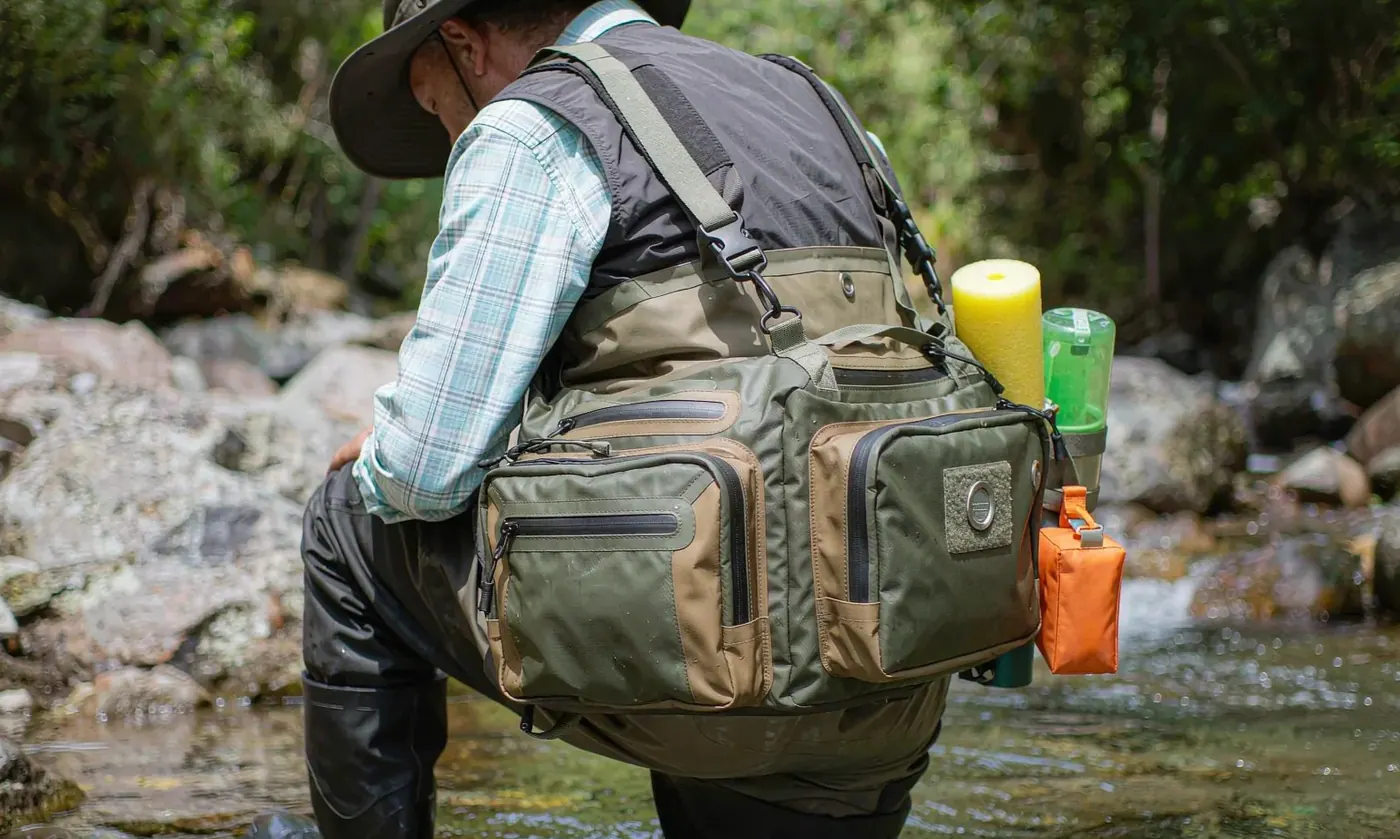
The decision between a larger bag on a cart and a smaller bag on the back comes down to pier length and how much bait is carried. On a short pier with frozen bait, a 40 litre backpack at 10 kilograms is genuinely better than a cart, because the angler keeps both hands free and moves faster. On a long pier with live bait, the cart is not optional.
Where a cart is used, the bag should be shaped to strap to it, which means flat back panels, four external attachment points and no protruding side pockets that foul the wheels. Considerations for wheeled versus carried tackle are set out in the rolling versus backpack tackle bag comparison, and heavy-duty deck designs in the best offshore tackle bag review.
One more consideration applies to piers specifically and rarely comes up elsewhere: the bag may have to be carried up and down stairs or a ladder to a lower deck. A bag with a grab handle at the top and one at the side can be passed down hand to hand, and a bag that fits through a 600 millimetre gap is much easier to manage than one that does not. Measuring that before buying avoids the common discovery that a 60 litre bag cannot be taken to the spot where the fishing is best.
Specification Notes for Programme Buyers
QUANZHOU JUNYUAN BAGS has run waterproof bag programmes since 2014, with a founding team in this industry since 2004. Output is 200,000 units a month, verified by SGS, under BSCI and ISO 9001 governance, with materials screened for REACH and California Prop 65 and every order inspected at AQL 2.5. A pier brief should open with carry distance and bait type, because those decide volume, base width and whether a cart interface is part of the design.
Then specify hardware grade, zip type and chain material, closure style, base construction and texture, attachment points for rail hooks, colourway and quantity. Salt resistance claims should reference a recognised salt spray method published by ASTM International so they can be verified, and marine exposure and weather planning data is available from the National Oceanic and Atmospheric Administration. Five hundred pieces per design and colour is the opening order size. Sampling runs six to ten working days, bulk thirty-five to fifty days from approved sample and deposit, and shipment is FOB Xiamen or DDP to upwards of one hundred nations. Send briefs to service@junyuanbags.com.
People Also Ask
What size bag is best for pier fishing?
Forty to sixty litres with a wide moulded base. Volume matters less than footprint: a base over 300 by 220 millimetres resists tipping in wind up to forty-five kilometres per hour.
Do I need a cart for pier fishing?
Above fourteen kilograms, yes. A ten litre bait bucket full of seawater weighs eight to twelve kilograms on its own, which is most of the load.
What waterproof rating should a pier bag have?
IPX6. Driven spray at forty kilometres per hour resembles a powerful water jet, which is exactly what the IPX6 jet test simulates and IPX5 does not.
How do I stop a bag blowing over on a pier?
Widen the base, put the densest two kilograms in the bottom of the bag, and clip the base loops to a rail or bench leg.
How do I stop salt corroding pier gear?
Rinse with fresh water within four hours, work every zip under running water, and dry open for twelve hours. Chloride needs moisture to keep corroding.
Is stainless hardware worth it on a pier bag?
Yes. Zinc or nickel plated fittings show stiffness at about eighty hours of salt exposure and pitting later; 316 stainless or marine polymer avoids it at source.
Frequently Asked Questions
Q1. What makes a bag a pier fishing bag?
A wide, low, grippy base for wind and wet decking, corrosion-resistant hardware for salt spray, and a shape that straps to a pier cart or clips to a rail.
Q2. How heavy is a typical pier fishing kit?
Fourteen to twenty-two kilograms with live bait, and eight to twelve kilograms with frozen bait and a reduced kit.
Q3. Should a pier bag be a backpack or a rolling bag?
A backpack under fourteen kilograms and a pier cart above it. The bait bucket, not the tackle, is usually what pushes the load over the line.
Q4. What wheels work best on a pier?
Solid wheels of 150 to 250 millimetres with sealed bearings. Small wheels catch on planking gaps and pneumatic tyres puncture on shell and hooks.
Q5. How much wind can a pier bag tolerate?
A wide-based bag with its weight low stays upright to about forty-five kilometres per hour. Above fifty, anchor it or hang it from a rail.
Q6. Can I keep live bait in the bag?
Only in a sealed bucket with an aerator, and preferably on the cart rather than in the bag. Eight litres of seawater weighs eight kilograms.
Q7. How long does frozen bait stay frozen in a bag?
Four to five hours in summer in a compartment of at least ten litres with eight to ten millimetres of closed-cell foam.
Q8. What hardware grade should I specify for a pier bag?
316 stainless or marine-grade polymer. Plated fittings stiffen at roughly eighty hours of salt exposure and pit later, which is structural.
Q9. Should a pier bag have rod holders?
Yes, two, angled ten to fifteen degrees off vertical. Leaning rods on a shared rail in a crowded space is how rods get broken.
Q10. How soon should I rinse a pier bag after a trip?
Within four hours, at low pressure, working every zip and buckle. High pressure drives salt deeper into seams rather than removing it.
Q11. What is the MOQ for a pier-specific carry programme?
Five hundred pieces per design and colour, with six to ten working days for sampling and thirty-five to fifty days for bulk from approved sample and deposit.