A trout or small-stream bag should weigh under 1.6 kilograms loaded, sit where it can be opened with one hand while standing in current, and reach no lower than the wader belt so it stays clear of the water. The configuration that satisfies all three is a 6 to 14 litre chest or sling pack with two to four fly or lure boxes, a tippet or leader spool holder, and an IPX5 spray rating rather than a full immersion rating. Anything bigger than 20 litres becomes a bank bag in practice, because a loaded backpack cannot be swung to the front in waders without breaking the seal of the wader belt. Programme buyers should allow 500 pieces per design and colour, six to ten working days for a sample, and thirty-five to fifty days for bulk.
The Weight Budget for a Day on a Small Stream
Trout fishing is a walking discipline, and the load should be built from that fact rather than from the tackle that exists in the garage. A realistic summer kit is two fly boxes at 90 to 140 grams each, a tippet holder with four spools at 120 grams, a spool of leader material, forceps and nippers at 130 grams, a small net slung separately, water at 500 grams, and a packable shell at 300 grams. That is 1.3 to 1.7 kilograms including the bag, and it is the number a stream bag should be sized around.
Every extra 500 grams matters more here than in any other branch of fishing, because stream fishing involves repeated scrambling over banks and boulders where a heavy pack shifts the centre of mass and turns a step into a fall. At 2.5 kilograms loaded, most anglers report noticeably worse footing on wet rock, and that is a safety issue rather than a comfort one.
| Item | Weight | Carried where | Why that position |
|---|---|---|---|
| Two fly or lure boxes | 180 to 280 g | Main compartment, front panel | Opened twenty to forty times a day |
| Tippet or leader spools | 100 to 140 g | External spool dock | Needed while a fish is on |
| Forceps, nippers, knot tool | 110 to 160 g | Zinger on the shoulder strap | One-handed, never stowed |
| Water, 500 ml | 520 g | Side pocket or hydration sleeve | Weight low and central |
| Packable shell | 250 to 350 g | Bottom compression straps | Only unpacked in rain |
| Phone and licence | 180 to 240 g | Lined top pocket | Highest point in the pack |
Why Wading Changes Everything About the Bag
Standing in water to mid-thigh changes three things at once. The angler cannot set the bag down, cannot reach behind the hips comfortably while wearing a wader belt, and cannot afford to let anything dangle into the current. A backpack of any real size fails all three tests, because its whole design assumes access from behind and a place to stand while opening it.
The practical rule is that the bag must be able to rotate from the back to the front without being taken off, which is exactly what a sling strap does and what a twin-strap harness cannot. Where a twin-strap pack is preferred for longer walks, the compromise is a chest pack worn in front plus a very light day pack behind, splitting the load 60:40 and keeping the working items at the front.
| Bag position | Suits | Access while wading | Maximum useful volume |
|---|---|---|---|
| Chest pack | Nymphing, short walks under 2 km | Excellent, always in front | 6 to 9 litres |
| Sling pack | Mixed spin and fly, 1 to 5 km | Excellent, swings forward | 9 to 14 litres |
| Waist pack | Warm weather, shallow water | Good, sits at the belt | 5 to 8 litres |
| Small backpack | Long walks to remote water | Poor, must be removed | 18 to 24 litres |
| Vest | Technical nymphing with heavy kit | Excellent but bulky | Equivalent 10 to 14 litres |
Anyone weighing sling against waist carry for moving water will find the detailed argument in the sling versus waist pack comparison, and the wider selection of wading designs in the best wade fishing bag review.
Small Items: The Real Problem on a Stream
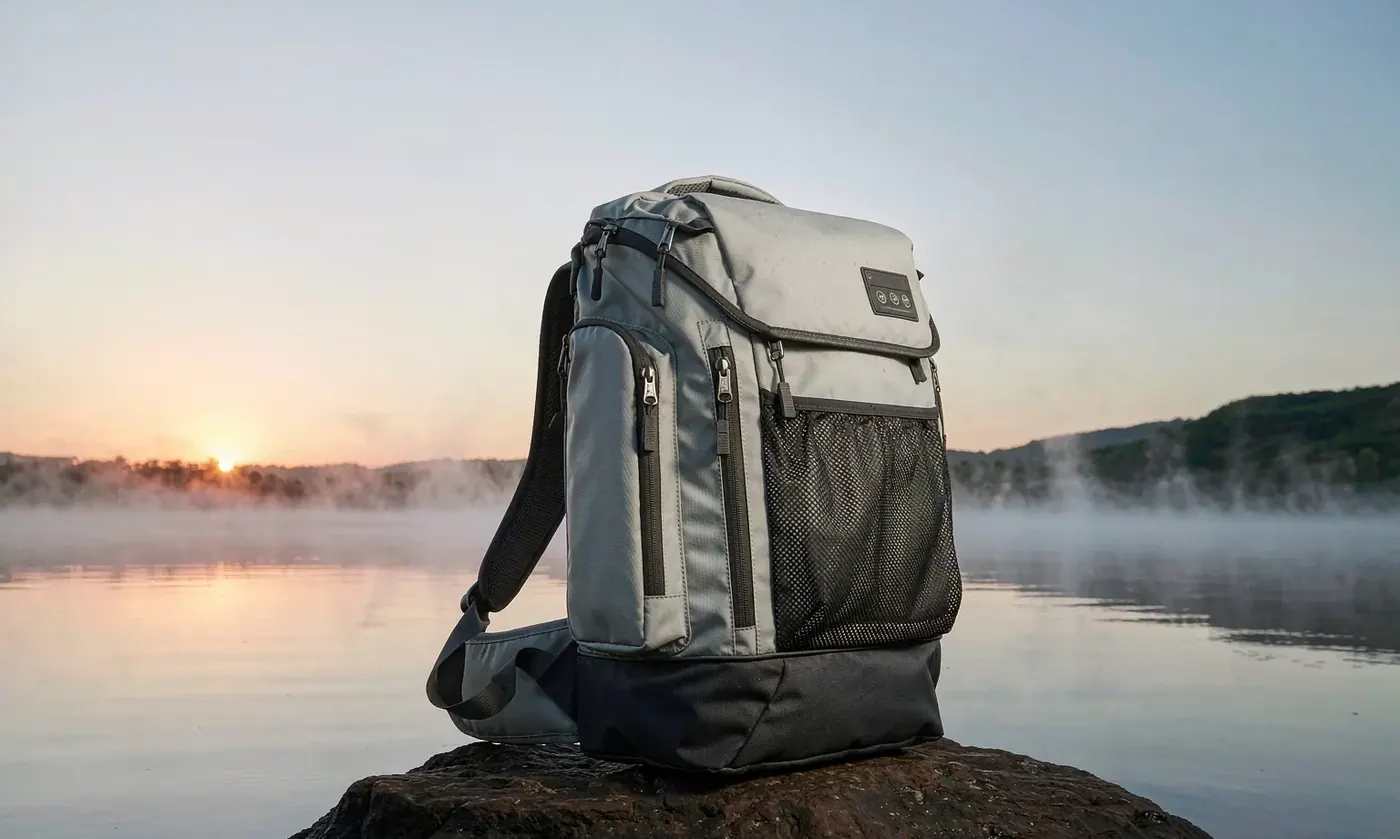
Trout tackle is a problem of small objects rather than heavy ones. Size 18 to 22 hooks, split shot under 3 millimetres, tippet spools of 25 millimetres diameter, and indicators the size of a thumb nail are all easy to lose in a single undivided cavity, and losing them in a bag while standing in current means losing them for good. Divided storage is not a luxury at this scale; it is the entire point of the bag.
- Give every item class a fixed home and never rotate it, because muscle memory is what makes one-handed access work.
- Use a shallow tray or a fold-out wallet rather than a deep pocket for anything under 30 millimetres across.
- Fit a retractable zinger for forceps and nippers, so tools return to the same point after every use.
- Keep split shot in a tin with a magnetic base; loose shot in fabric is found months later, embedded in the lining.
- Carry one tippet spool of each size in use rather than three of one size, which is the common over-packing error.
One-Handed Access: What It Actually Requires
One-handed access is quoted constantly and specified rarely. It requires three things to be true at the same time: the pack can be rotated to the front in under two seconds, the main opening can be released with a single pull rather than a zip along a curve, and the interior is visible without turning the pack away from the angler. Magnetic closures satisfy the second test, curved zips do not, and a drop-front panel satisfies the third while a top loader does not.
The test is simple and worth running in a shop. Load the pack, put it on, stand on one leg as if balancing on a rock, and try to remove a specific fly with the rod held in the other hand. If it takes more than ten seconds, the pack is a bank pack. Most magnetic-closure chest packs achieve four to six seconds; most top-loading slings take fifteen to twenty-five.
Pack position on the back changes the result by a few seconds in either direction. A sling worn too low, with the body of the pack below the hip bone, adds three to five seconds because the rotation passes through the wader belt and has to be lifted over it. Worn high, with the top of the pack between the shoulder blades, the same swing takes under two seconds. That single adjustment of roughly 60 millimetres of strap length is the free improvement most anglers never make.
Waterproofing at Chest Depth
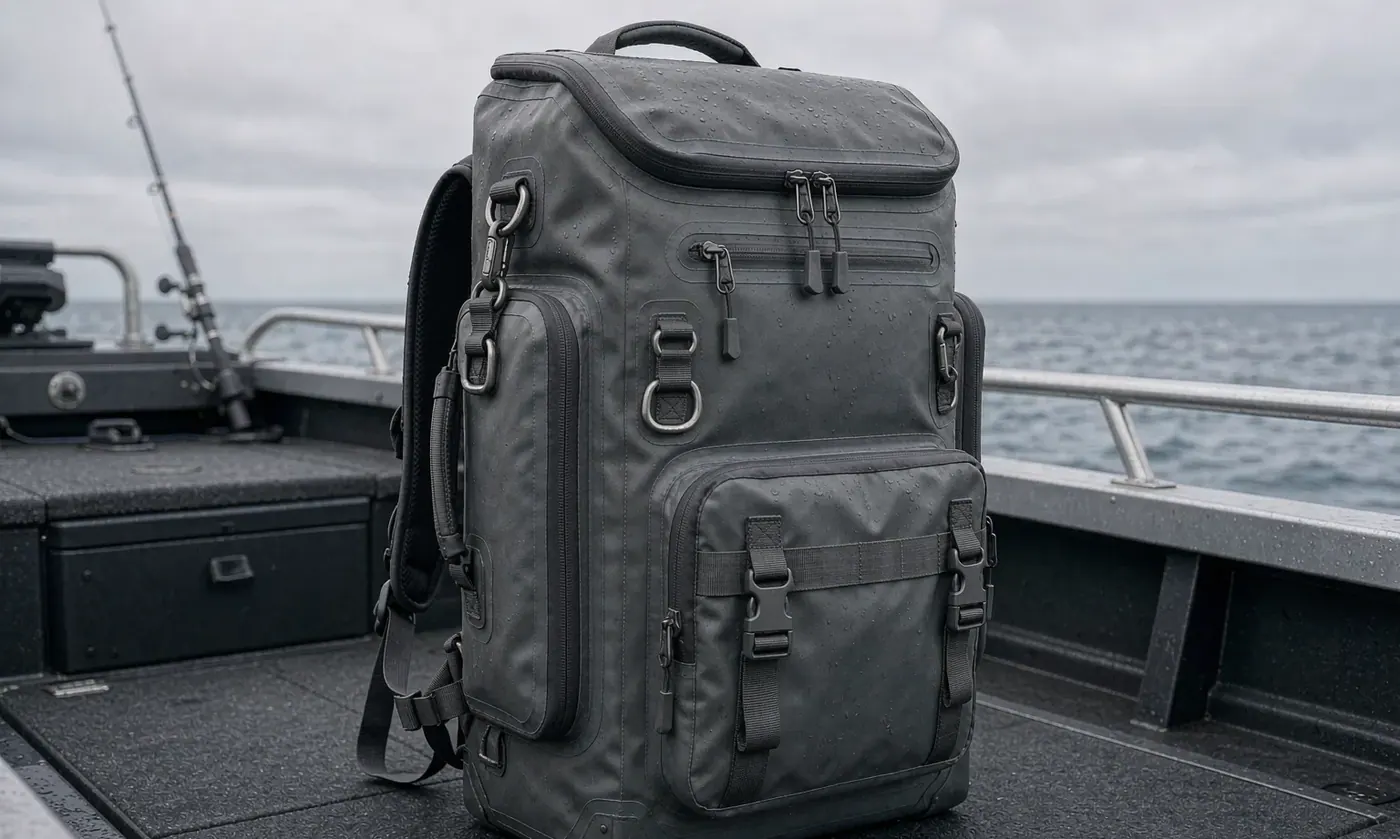
A stream bag rarely gets submerged deliberately, but it gets rained on for hours, splashed at every crossing, and occasionally dunked when the angler slips. That puts the useful target at IPX4 to IPX6 depending on how much of the day is spent in moving water, with IPX5 being the sensible default: protected against low-pressure water jets from any direction, which covers rain plus splash plus a slip to one knee.
A submerged pack is a different matter and should be treated as an emergency rather than a design case. If the pack does go under, everything paper-based inside is lost within thirty seconds and a phone in anything less than a sealed pouch is at risk within ten. That is why the top lined pocket, not the main compartment, is where the phone belongs. The rating codes are set out in the IPX rating guide, and the underlying enclosure test method is published by the International Electrotechnical Commission.
Cold Water, Wet Hands and Closure Choice
Cold hands are the reason trout anglers abandon gear that works perfectly well in summer. A zip pull that can be operated with numb fingers needs to be at least 25 millimetres long and have a cord loop rather than a flat metal tab, because a flat tab cannot be gripped through a glove. Magnetic closures fail the same test in a different way: they open easily, but they also open accidentally when the pack is pressed against a rock.
Water temperature matters here for physiological reasons as much as practical ones. In water below 15 degrees, cold immersion reduces manual dexterity measurably within ten to fifteen minutes, and guidance on cold water immersion risk is published by the United States Centers for Disease Control and Prevention. Stream levels and weather are worth checking against published forecasts before committing to a long walk-in.
Nets, Rods and Landing While Wearing a Pack
Landing a trout while carrying a pack is a choreography problem. The net has to be reachable without the pack swinging, and the rod has to be held clear while the fish is worked. A net slung from a magnetic release at the rear of the shoulder or belt is the standard solution, and the magnet should be rated at 2 to 3 kilograms of pull so it holds a wet net but releases on a deliberate tug.
Where the rod has to be put down to net a fish, the pack should offer a rod loop or a short tube that holds the butt while the angler works. That loop should sit on the outside of the pack rather than the centre, because a rod stowed centrally catches the elbow on every cast. Roughly 40 percent of stream anglers who carry a pack at all carry some form of rod retention, and it is the accessory most often added after the fact.
Hydration and Food on Long Walk-Ins
A long walk-in to remote water turns a fishing bag into a small day pack, and hydration is the first thing that gets under-planned. Working output on a steep gradient in waders is roughly 400 to 600 millilitres of fluid per hour in cool weather and up to 900 millilitres in warm weather, so a four hour round trip needs between 1.5 and 2.5 litres carried or a reliable source on the water. That weight has to be budgeted from the start rather than added at the car.
| Carry option | Volume | Weight full | Suits |
|---|---|---|---|
| Soft flask in the main compartment | 500 to 750 ml | 520 to 780 g | Chest packs and small slings |
| Insulated side sleeve | 500 to 1000 ml | 540 to 1040 g | Sling packs of 9 litres and up |
| Hydration bladder in a rear sleeve | 1.5 to 2.0 litres | 1560 to 2080 g | Small backpacks on long walk-ins |
| Filter bottle filled at the stream | 650 ml plus filter | 600 g plus 90 g | Remote water with a known safe source |
Food has its own rule on a stream: nothing that needs two hands and nothing with a strong scent. Scented wrappers and food residue in a pack attract everything from ants to mice overnight, and a pack left closed with a half-eaten bar inside is a pack that will be chewed into by spring. Where a full day is planned, pack food in a sealed pouch and take the pouch out of the pack at the end of the day without exception.
Stillwater and Lake Trout: A Different Carry
Trout fishing from a lake shore or a float tube is close enough to stream fishing to share most of the kit and different enough to change the bag. The walk is shorter, there is no wading, and there is usually a place to set the bag down, which means a larger pack becomes usable again and the pressure to keep everything one-handed disappears. Volume of 18 to 24 litres and a proper harness are both back on the table.
The compensation is exposure. Stillwater anglers sit or stand for long periods in wind and rain with no shelter, so a pack with a rain cover or a genuinely waterproof shell earns its keep in a way it does not on a sheltered stream. Line management also changes: stillwater fishing uses longer leaders and often a sinking line, and a pack with a flat external pocket for a line wallet avoids the tangles that come from putting line spools back in a divided compartment.
Seasonal Load: From Caddis Hatch to Autumn Spawn
The bag for a May caddis hatch and the bag for an October brown trout session are not the same bag, and pretending otherwise is how anglers end up carrying 2.5 kilograms of unused kit in spring. Volume should follow the hatch calendar, with the largest box count in late spring and the smallest in high summer.
| Season | Water temperature | Boxes carried | Typical load | Pack size |
|---|---|---|---|---|
| Early spring | 4 to 9 degrees | 3 boxes, nymphs and small streamers | 1.4 to 1.8 kg | 9 to 14 litres |
| Late spring hatch | 10 to 16 degrees | 4 boxes, dries and emergers | 1.5 to 2.0 kg | 12 to 16 litres |
| High summer | 16 to 22 degrees | 2 boxes, terrestrials | 1.0 to 1.3 kg | 6 to 9 litres |
| Autumn spawn | 8 to 14 degrees | 3 boxes, eggs and streamers | 1.4 to 1.8 kg | 9 to 14 litres |
The pattern is simple: box count tracks insect diversity, not angler enthusiasm. Carrying four boxes in August adds 400 grams and earns nothing, because the fish are looking at three patterns and the angler will use two of them.
Drying a Bag That Went In
A stream bag goes in the water eventually, and what happens in the following six hours decides whether it smells by next spring. Empty every pocket the same day, remove the fly boxes and shake them open, and dry the pack upside down with all closures open in moving air for at least twelve hours. Do not use a radiator, a boot dryer or a hair dryer on high, because sustained heat above 60 degrees degrades coatings and shrinks some linings.
Two details are worth building into the routine. Silica sachets of 10 grams in each box compartment cut visible corrosion on hooks dramatically over a season, and a monthly rinse in fresh water removes the mineral film that stream water leaves in fabric. Full drying method is in the drying a wet fishing bag guide, and seasonal storage in the off-season storage walkthrough.
Choosing Between Chest, Sling and Waist for Your Water
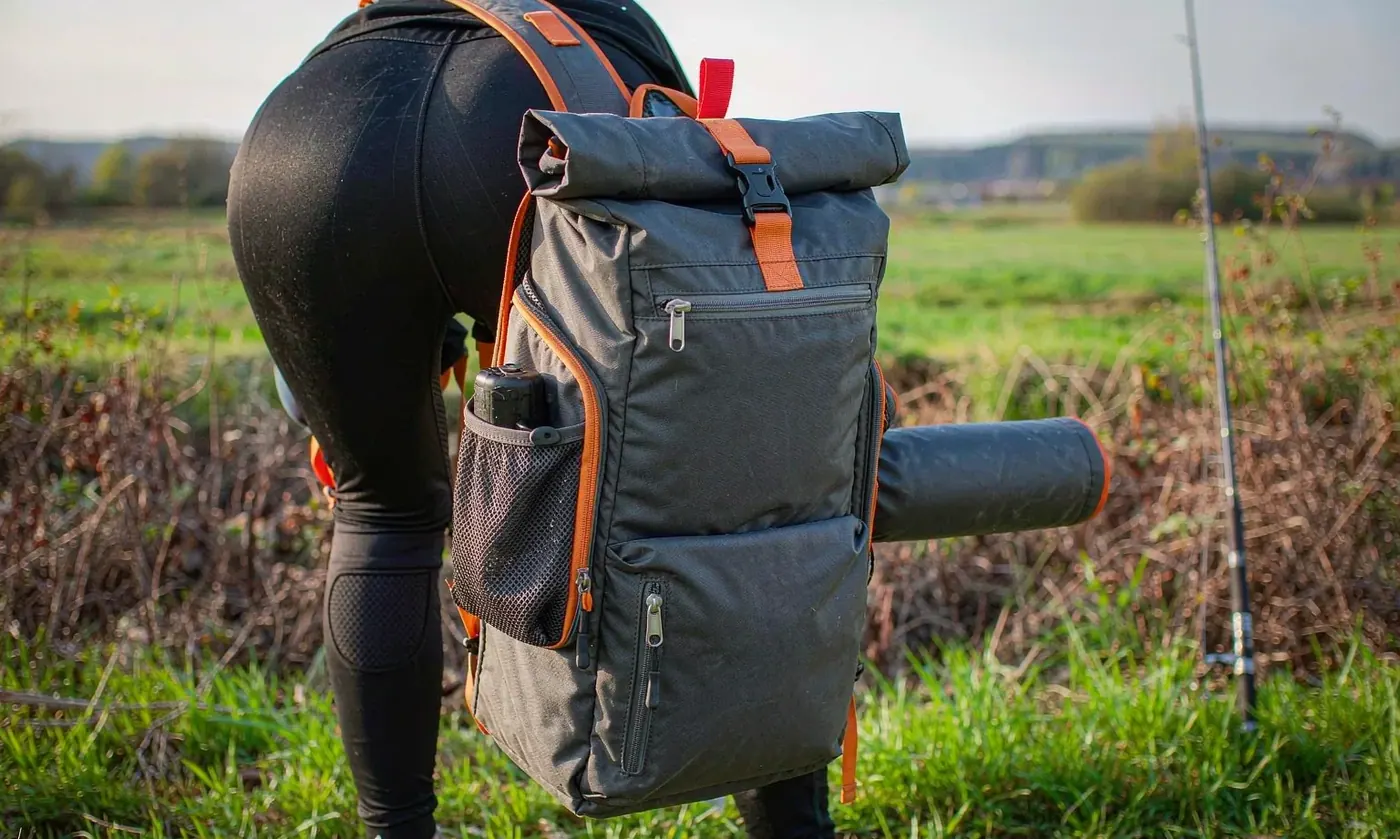
The decision comes down to three questions that can be answered in advance: how far is the walk, how deep is the wading, and does the angler change method during the day. Short walks plus deep wading plus a single method points to a chest pack. Medium walks plus moderate wading plus two methods points to a sling. Warm weather plus shallow water plus minimal kit points to a waist pack.
Where two methods are carried, a spinner and a fly rod for example, the sling is the only comfortable answer because it alone allows the pack to be moved out of the way of a casting arm in one motion. Selection detail for the waist option sits on the fishing waist pack page, and for fly-specific layouts on the fly fishing bag page.
Specification Notes for Programme Buyers
QUANZHOU JUNYUAN BAGS has worked on waterproof bag programmes since 2014, with a founding team in this industry since 2004. Output reaches 200,000 units a month, verified by SGS, under BSCI and ISO 9001 governance, with materials screened for REACH and California Prop 65 and every order inspected at AQL 2.5. For a stream bag, the brief should open with carry position and target loaded weight, because those two decide the harness geometry before any pocket layout is drawn.
Add closure type and pull length, internal division count, net magnet rating, hardware grade, shell material and coating thickness, colourway, and quantity. Fabric and seam performance claims are worth referencing to published test methods from ASTM International so they can be verified rather than argued. Five hundred pieces per design and colour is the opening order size. Sampling runs six to ten working days, bulk thirty-five to fifty days from approved sample and deposit, and shipping is FOB Xiamen or DDP to upwards of one hundred nations. Send briefs to service@junyuanbags.com.
People Also Ask
What size bag is best for trout fishing?
Six to fourteen litres worn as a chest or sling pack. That carries two to four fly boxes, tippet, tools, water and a shell at 1.3 to 2.0 kilograms.
Should a trout bag be worn on the chest or the back?
On the chest or swung to the front. Wading prevents setting a bag down, so any pack that cannot rotate forward becomes unusable in current.
Do I need a fully waterproof bag for stream fishing?
IPX4 to IPX5 is enough for rain and splash. Full IPX7 or IPX8 immersion ratings add weight and cost for a case that happens rarely.
How heavy should a loaded trout pack be?
Between 1.3 and 2.0 kilograms. Above 2.5 kilograms, footing on wet rock deteriorates noticeably, which is a safety issue rather than a comfort one.
Can I wade deep while wearing a waist pack?
Yes to about mid-thigh. Above that the pack floats and rides up the belt, so a chest or sling pack is the better choice for deep wading.
What closure works best with cold, wet hands?
A magnetic drop-front closure for speed or a zip with a 25 millimetre cord loop for security. Flat metal zip tabs cannot be gripped through a glove.
Frequently Asked Questions
Q1. What makes a bag wader-friendly?
It rotates to the front without being removed, sits above the wader belt, and opens one-handed. A twin-strap backpack fails all three tests in current.
Q2. How many fly boxes should a trout sling pack hold?
Three to five slim boxes. Slim boxes matter more than count, because deep boxes stack and the bottom one becomes unreachable in a shallow pack.
Q3. Is a vest better than a sling pack for trout?
A vest carries more and distributes weight better for long technical nymphing days, but it is hot in summer and cannot be removed quickly. A sling suits most anglers.
Q4. What should be in the top pocket of a stream pack?
Phone and licence only, in a lined or sealed pouch. It is the highest point in the pack and the driest if the pack goes under.
Q5. How do I stop a sling pack swinging while casting?
Tighten the strap until the pack sits high on the back, and use the secondary stabiliser strap. Most swing comes from a strap left 50 millimetres too long.
Q6. Can a trout bag carry a rain shell?
Yes if the pack is 12 litres or more, or a shell can be strapped under the compression cords of a 9 litre pack. Below that, use a waist pouch.
Q7. What magnet strength should a net release have?
Two to three kilograms of pull. Less and a wet net drops on every bend; more and it will not release on a deliberate tug.
Q8. Do chest packs interfere with wading belts?
They can, if the pack bottom hangs below the belt. Adjust the neck strap so the pack base sits 30 to 60 millimetres above the belt line.
Q9. How often should I dry a stream pack fully?
After every session where it got wet, and for at least twelve hours with all pockets open. Once a month, rinse in fresh water to remove mineral film.
Q10. Will a small sling pack hold a water bottle?
Most 9 litre and larger slings take a 500 millilitre bottle in a side pocket. Below 9 litres, plan on a soft flask in the main compartment.
Q11. What is the MOQ for a stream or wading pack programme?
Five hundred pieces per design and colour, with six to ten working days for sampling and thirty-five to fifty days for bulk from approved sample and deposit.