For an outfitter running commercial whitewater, a dry pack is shared hardware bought by the rack rather than a personal purchase. Specify one welded TPU hull that survives half an hour beneath 1 m of water, issue it as 25 to 35 L modules at two or three units per raft, and hold a floating reserve worth roughly 18 percent of issued count. Plan the contract from a 500-unit entry per artwork and colourway, allow six to ten working days for prototypes and thirty-five to fifty days for production, and pull inspection at AQL 2.5 on arrival. Everything below — graded builds, turnaround hygiene between guest parties, post-flip accounting and written retirement rules — keeps a twenty-boat operation supplied across a hundred-day season without emergency orders.
Sizing the Rack: What One Raft Actually Consumes
Trip leaders rarely want one enormous sack. They want parts that repeat. Passengers arrive with nothing suitable, so the operator issues the dry storage, and that makes quantity a purchasing decision rather than a taste question. Start from the frame: once the rower box, cooler and oar towers are placed, the clear bays left for soft goods on standard 38 mm pipe sit roughly 380 to 520 mm across. Two mid-size cylinders drop into that envelope without fouling the throw line, and they can be walked fore or aft to balance a boat loaded unevenly by passenger weight.
| Vessel layout | People aboard | Units issued | Capacity split | Standby rule |
|---|---|---|---|---|
| Six-seat paddle raft | 6 clients plus guide | 3 units | Two 25 L and one 35 L | One standby per four boats |
| Four-seat oar rig | 4 clients plus rower | 2 units | One 20 L and one 30 L | One standby per five boats |
| Support cataraft | 2 crew | 2 units | Twin 40 L bodies | One standby per six boats |
| Overnight cargo raft | 8 aboard | 4 units | Two 40 L plus two 30 L | One standby per three boats |
| Escort safety kayak | 1 paddler | 1 unit | 18 L low profile | Drawn from the pool only |
Turn that table into an order with simple arithmetic. Multiply boats by units issued, then round upward to a production-friendly quantity. Twenty rafts at three units apiece means sixty issued plus sixteen in standby, so the opening purchase lands near eighty and clears the entry minimum comfortably.

Count of identical units matters more than the exact litre printed. Twenty matching 30 L cylinders replace cheaply and move between vessels with no thought. A collection of 15, 45 and 65 L shapes forces new guides to consult a chart and still get it wrong.
Consolidation also decides price. Because an entry programme opens at 500 pieces per design and colourway, even a modest operator usually rolls two seasons of replacement demand into one shipment, splitting five hundred across the 25 L and 35 L shells in a sixty-forty ratio. See the MOQ and lead-time planning guide for how those bands interact with artwork counts and shipping method.
One Base Specification, Graded Three Ways
Buying a single protection level across a mixed booksheet wastes money on gentle water and leaves a hole on steep water. Write one foundation — welded seams with no needle holes in the load path, a stiffened top, four reinforced loops, drainage that cannot trap grit — then vary shell mass and top hardware against the rivers each group actually runs. A day-float boat never meets hydraulic pressure; a steep creek boat meets nothing else.
| Operating band | Share of rack | Shell build | Top hardware | Re-verification |
|---|---|---|---|---|
| Scenic float, easy rapids | 25 to 35 percent | 420D TPU near 0.35 mm | Covered coil slider | Sight check each month |
| Class III day trips | 40 to 50 percent | 600D TPU at 0.45 mm | Triple-fold collar with bar | Wet audit every six weeks |
| Dam-release technical water | 15 to 20 percent | 600D at 0.50 mm plus base panel | Triple fold and hook lock | Soak retest monthly |
| Steep creek pin hazard | 5 to 10 percent | Reinforced corners in 840D | Rated submersible slider | Retest before each launch |
| Shuttle and portage carry | around 5 percent | Any 420D body | Simple top fold | Start and end of season |
Those codes describe test conditions, not adjectives. Ask for the depth, the duration and the ballast weight used, since a claim proved empty tells a buyer little. Background definitions are set out in the IEC enclosure rating summary published by the standards body.
Shell thickness alone does not settle durability. Abrasion against a crossbar under a loaded boat kills far more units than immersion does, so combine thickness with weld geometry: 18 to 22 mm seam width wherever load travels, with each reinforcement plate spreading force at least 40 mm past the webbing loop. Background on that relationship is in the coating thickness and construction article. A heavier cloth cannot rescue a thin weld.
Hygiene Between Unrelated Guest Parties
Shared dry storage passes from stranger to stranger several times weekly. Sweat, river silt, sunscreen and snack residue collect inside collar folds and along the base of drain pockets, and a unit handed over damp and gritty draws complaints far more reliably than a wet seat ever does. Put the cleaning step into the shuttle run, not into the evening: with supplies staged at the take-out, one boat set takes about eight minutes to turn around.
| Contact area | Turnaround action | Working time | Hand-back check |
|---|---|---|---|
| Collar faces | Neutral detergent wipe, clean rinse | 90 s per unit | No grit under a dry thumb |
| Buckle springs and webbing | Agitate under running water | 30 s | Springs recompress fully |
| Interior compartment | Empty, invert, passive airing | 5 min | No odour, no visible film |
| Drained outer sleeve | Hose through, brush seam corners | 60 s | Runs clear, no sand trail |
| Guide-marked units | Full wash each 20 guest days | 12 min | Signed on the unit card |
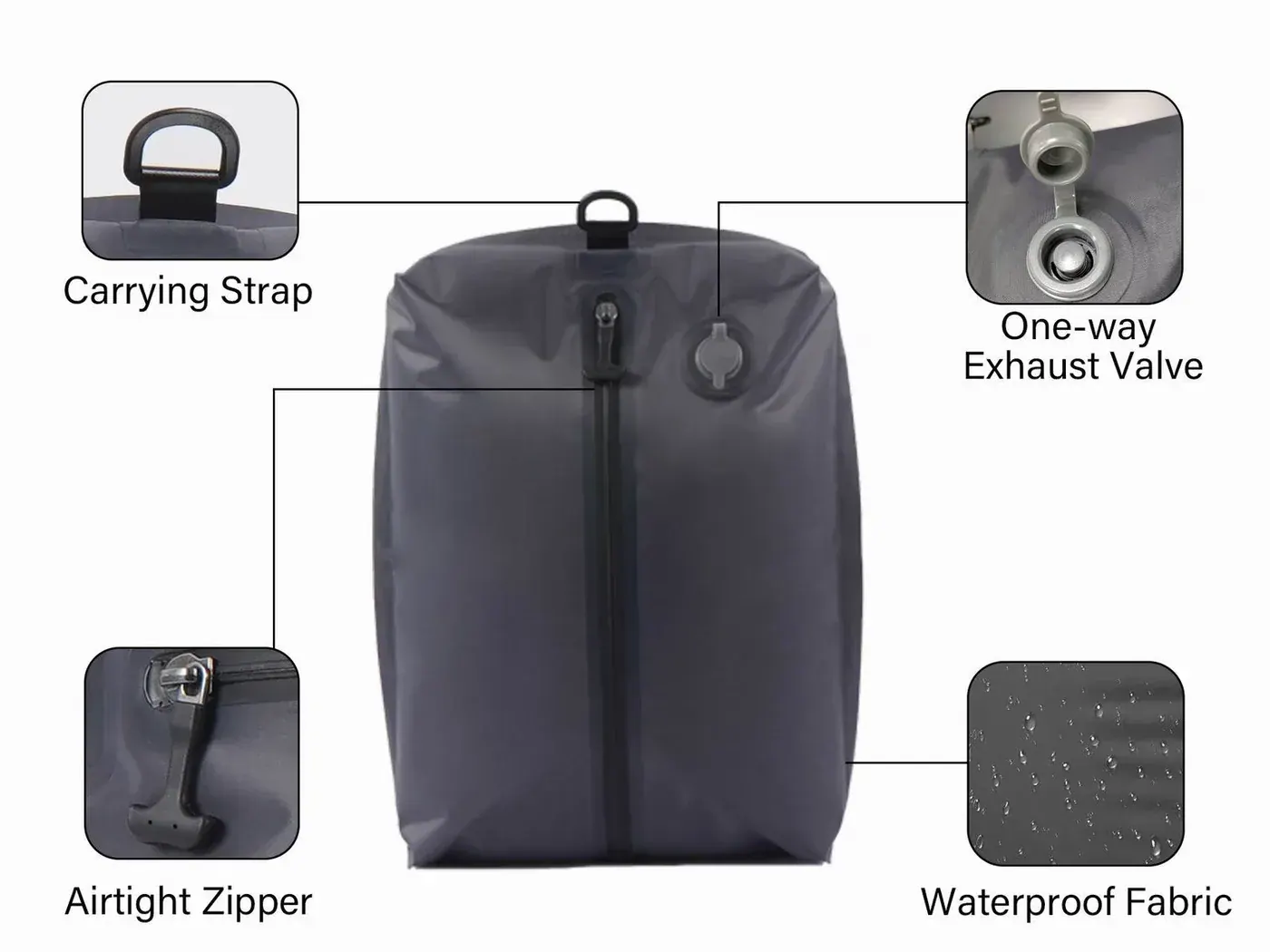
Use a mild pH-neutral detergent mixed to label strength, applied with a soft cloth, followed by clean water over every buckle spring. Strong solvent cleaners strip the film off a TPU face and can remove a full season from a 600D body in a single careless afternoon. Product choice is worth checking against the EPA Safer Choice ingredient screening programme, which helps avoid agents that haze coatings or leave residue transferring onto client clothing.
Drying is the stage operations quietly skip. Hang units open, mouth downward, in a shaded rack with moving air; a fan-assisted room turns a twenty-unit day set around within roughly eight hours at ordinary indoor temperature. Keep dark shells out of direct desert sun — surface temperature on black laminate can pass 60 degrees Celsius at midday, which is enough to relax weld lines after repeated exposure. The full washing routine is set out in the step-by-step cleaning guide.
Numbering, Colour Bands and Zone Discipline
An unmarked unit will eventually be lost, and no one will know which boat to blame. Give every item a permanent three-part identity: vessel number, frame position and service grade. A heat-applied synthetic label sewn inside the collar survives hundreds of wash rounds; felt-tip marker does not survive one. Laminate the one-page key and keep it in the rigging shed rather than in a manager folder.
| Marker | Where placed | Format | Operational reason |
|---|---|---|---|
| Unit number | Inner collar, below the fold line | Boat plus slot code | Ties any loss to vessel and bay |
| Grade band | Upper panel and base binding | Three hues maximum | Right build reaches the right river |
| Zone tag | Loop tape outside, 40 by 25 mm | Dry, crew or wet icon | Correct compartment opened mid-run |
| Year dot | Beside the top closure | Rotating annual colour | Age visible without opening records |
| Repair flag | Cable tie at the handle root | Dated paper tab | Stops a suspect unit being issued |
Colour should encode something, otherwise it is decoration. Where orange means immersion-grade for technical boats and charcoal means day-float stock, a guide builds an entire rig by eye in under a minute before dawn. Hue selection interacts with recovery too; the colour and visibility notes cover how tones read against brown glacial water.
Zone tags prevent the common contamination argument. DRY marks the sealed interior holding phones, medication and spare clothing, CREW denotes layers the working team may reach and WET labels the drained sleeve carrying ropes, river shoes and the bail bucket. The sealed interior stays shut while afloat.
Flip Protocol: Retrieval, Triage and the Same-Day Count
Any operation running paying guests will eventually lose a loaded unit in current. Write the procedure before it happens, rehearse it twice a season, and keep the form printed at the take-out. People come first without exception; reconciling hardware starts once the crew is counted ashore, normally inside the following ten minutes.
- Account for every person before any object leaves the water, then again once the boats are rafted.
- Log the last sighting with a landmark and bearing rather than a vague distance downstream.
- Send the support craft on a pickup sweep rather than swimming clients into the same current.
- Record the unit identity on the wet-loss sheet the same shift, never the following morning.
- Open a recovered unit on the beach, note contents condition and dry or discard items immediately.
| Stage | Owner | Clock target | Evidence produced |
|---|---|---|---|
| Head count | Trip lead | Immediate | Signed people count |
| Shore sweep | Second guide | First five minutes | Bearing and landmark note |
| Pickup pass downstream | Support boat | Five to twenty minutes | Recovery pin from the phone |
| Unit flagged as wet loss | Base office | Same working day | Identity added to loss register |
| Contents condition check | Guide crew | Before leaving the gravel bar | Itemised damage note |
| Replacement or claim | Operations manager | Under 24 hours | Pool draw or insurance entry |
Give every unit enough internal air to be seen. A partially filled body rides high enough for the handle to break the surface, while a fully compressed one carrying dense camera blocks behaves like stone. Operators generally standardise on leaving about a tenth of internal space as headspace — near three litres on a 30 L shell — enough to show colour downstream and not enough to balloon the closure under load. Float behaviour shifts markedly with contents, a subject covered further in the flotation behaviour reference.
A written loss register is what separates a well-run operation. Losses counted per hundred guest days is a number insurers and managers both understand; most disciplined operations sit between 0.2 and 0.5, and a figure climbing past that points at lashing rather than luck. Each entry carries the vessel number, the frame bay, the strap used and the guide name, so patterns show up inside a month.
Attach using four reinforced loops arranged as opposing pairs, with 20 to 25 mm cam straps around pipe or through dedicated frame rings, and never share a ring with the throw line. Keep roughly 200 mm free around foot cups and 150 mm clear of tower hardware so nothing jams or blocks rescue access.
Rotation Through the Season and the Repair Pool
Daily use wears a rack evenly, which sounds tidy and actually means every unit fails in the same fortnight. Rotate one service group off the water each week and each unit accumulates roughly fifteen percent fewer river days.
| Season activity | Volume handled | Service carried out | Return gate | Trace |
|---|---|---|---|---|
| Weekly group swap | A quarter of stock | Wash, dry, collar feel check | Visual pass before reissue | Sheet initialled by guide |
| Mid-season integrity sweep | Entire rack in one night | Seam survey and loop tug | Failures into the repair pool | Photographic defect list |
| Standby draw | As incidents occur | Pool unit issued to boat | Returned inside 48 hours | Loan card signed out |
| Repair batch | Fortnightly | Patch, re-weld, retest | Wet retest before return | Dated repair tab attached |
| Season close | Full complement | Strip, weigh, deep clean | Stored open, unrolled | Closing inventory file |
Fund the pool rather than the showroom. Standby stock near eighteen percent of issued units, backed by a turnaround arrangement returning repairable bodies within a fortnight, covers most losses. Pair it with consumed spares — buckle sets, webbing tails, closure stiffener bars, label stock — ordered inside the original container so hardware never travels by courier at air rates.
Track repair economics honestly. Labour, spare hardware and courier slips together usually stay under fifteen percent of replacement value across the first two seasons, then climb steeply once coatings begin chalking.
Acceptance at Goods-In: What to Sign For
A bulk shipment should never enter service on trust. Sample at AQL 2.5, then run a short physical script before anything numbered goes onto a frame. Weigh three units, measure seam width at four points with a steel rule, work every closure twenty times while wet, then soak one unit carrying nine kilograms of ballast at one metre depth for thirty minutes with absorbent indicator placed in the corners.
| Receiving activity | Sample drawn | Gate | File retained |
|---|---|---|---|
| Carton count and colour split | Every carton | Matches order within two percent | Signed packing list |
| Seam width where load travels | 3 units, 4 reads each | 18 mm minimum, no skipped sections | Photographed measurements |
| Immersion trial | 1 unit at 9 kg ballast | Indicator paper unchanged | Weights recorded before and after |
| Reinforcement tug test | 2 units | No creep at half a kilonewton | Short video per batch |
| Restricted-substance paperwork | Per material lot | Screening stated | Compliance statement file |
Paperwork is half the deliverable. Demand a packing list keyed to unit identities, per-lot REACH and California Prop 65 screening statements, resin lot references and weld parameter logs, so a later re-order can be matched rather than guessed. The compliance documentation explainer lists what a buyer should reasonably expect in that envelope.
Laboratory language helps both sides argue less. Coupons tested under recognised ASTM abrasion and peel procedures carry more weight than house numbers, provided samples are tested wet: the failure condition aboard a loaded raft is always a wet seam working against grit, never a dry coupon under a bench lamp. Welded construction principles are explained in more detail in the radio-frequency seam guide.
QUANZHOU JUNYUAN BAGS holds immersion footage, measured seam readings and unit numbering schemes for repeat programmes, so a second shipment can be matched to the first unit for unit instead of being approximated from a photo. Treat that record as part of the purchase rather than a courtesy.
Order Timing, Volume Tiers and Freight Mathematics
Timing ruins more programmes than price does. Count backwards from opening day: subtract ocean transit, then the production slot, then sample approval, then one contingency month for artwork delay or a failed prototype. A design signed off in February for a May first launch has almost no slack; the same plan started in November has comfortable room and better freight rates.
| Stage | Window | Constraint | Practical note |
|---|---|---|---|
| Brief and enquiry | Before minus six months | Volume plus artwork count | Locks the cost band |
| Prototype build | Six to ten working days | Per design and colourway | Two rounds are normal |
| Approved sample courier | Two to three weeks door to door | Clearance delay possible | Keep one golden sample |
| Production slot | Thirty-five to fifty days | Peak slots sell out early | Late artwork pushes the date |
| Ocean transit and clearance | 20 to 40 days into major ports | Season surcharges possible | DDP cover spans 100 plus countries |
| Numbering and issue | Ten to fourteen days | Inspection pulled at receipt | Label before first rigging |
Consolidation saves money in ways quotations hide. One order of five hundred split across two sizes ships in a single container and clears once, whereas three fragmented bookings pay three documentation sets and risk straddling a rate increase.
Replacement demand then follows a predictable curve: around twelve to twenty percent of issued units leave service after three hard seasons, with higher attrition on technical boats. Logging each retirement by cause — seam, hardware, closure or total loss — turns that estimate into evidence for the next contract. The year-round maintenance calendar fits those intervals into the operating year.
Judge Value Per Boat-Day Rather Than Per Unit
The lowest line item wins quotations and loses money. A reference ladder helps procurement teams compare honestly: unit price alone means nothing until divided by the guest days the unit survives, then burdened with the labour, freight and complaint handling that follow it.
| Cost line | Light construction | Heavy construction | Three-season effect |
|---|---|---|---|
| Purchase price | Lowest band | 25 to 40 percent higher | Gap spread across about three years |
| Serviceable seasons | One to two | Three to five | Fewer replacement cycles |
| Weld and patch incidents | Frequent | Occasional | Noticeable labour saving mid-season |
| Losses per 100 guest days | 0.5 to 0.9 | 0.2 to 0.4 | Less emergency freight |
| Guest complaint rate | Higher | Lower | Review scores and repeat booking |
Run that arithmetic across twenty boats: eighty cheap units retired after two seasons and replaced with rush freight often cost more over three years than heavier units refreshed at twenty percent in year four.
Variety carries cost too: every extra print position adds setup, so a fleet wanting distinct hues per river grade must accept higher pieces per colourway even where the total does not change. Three hues keeps each variant above the entry quantity.
Closing the Season and Spring Requalification
Storage mistakes age a rack faster than rivers do. Finish with a full wash, a clean rinse, then twelve hours drying wide open, followed by loose stuffing with paper and straps left undone. Avoid folding the top over itself for months: a collar creased in one position through winter loses pressure at that crease.
Before the next opening, requalify rather than assume. Draw one unit from each service group, load it with its working weight and soak it at one metre for thirty minutes with indicator slips inside. Then cycle closures while cold, around five degrees Celsius, because a chilled TPU face resists folding.
Write the retirement gate down and let any guide invoke it. Pull a unit when its collar no longer completes three full folds, when any reinforcement lifts beyond three millimetres under a firm tug, when chalking spreads across the coating, or when indicator slips show moisture after a repeated half-hour soak. Retired bodies still serve as shuttle carry or loan stock if labelled clearly, which stretches expenditure without risking a client's belongings.
Operators running mixed water can compare those issues against the wider boating water exposure notes and the sealed dry build buying page.
People Also Ask
How many dry packs should one commercial raft carry?
Three allocated units suits a six-seat paddle raft, two suit a four-seat oar rig and cargo boats take four. Multiply that across the fleet and add standby stock near eighteen percent so losses and repairs never leave a boat short.
Which top survives a raft flip better, a rolling collar or a sealed slider?
A triple-fold collar tolerates dirt, cold hands and rough treatment better and is easier for a guide to verify at a glance. A rated submersible slider earns its place only on steep creek boats where pinning under pressure is realistic.
How often should shared river packs be sanitised between guest groups?
Wipe the collar, rinse hardware and air the interior after every party, roughly eight minutes per boat at the take-out. A full detergent wash belongs on the schedule each twenty guest days or whenever visible silt remains after rinsing.
What standby inventory should an outfitter keep for dry packs?
Hold roughly eighteen percent of issued units as pool stock, plus buckle sets, webbing tails, closure stiffener bars and label blanks inside the original shipment. Arrange turnaround so repaired units return within about a fortnight.
Which specification suits day-float boats on gentle water?
A welded 420D body near 0.35 millimetres with a covered slider covers scenic work at low cost. Keep heavier 600D units with triple-fold tops for technical rivers where abrasion and immersion risk justify the higher price band.
How do operators track units lost during a flip?
Log the unit identity, vessel, frame bay and guide on a wet-loss register the same day, then count losses per hundred guest days. Anything above roughly half a unit points at lashing or anchor placement rather than bad fortune.
Frequently Asked Questions
Q1. What size river pack works for a six-seat commercial raft?
Issue two 25 L bodies and one 35 L body, split across the rear bay and the bow. That total fits standard 38 mm frame geometry, leaves rescue equipment clear and lets the crew trim the boat fore and aft.
Q2. Should every unit in a rental fleet reach IPX8?
No. Buy immersion-grade protection only for the five to fifteen percent of units that run steep or dam-release water. Scenic and day-float boats are served by lower-cost bodies rated for temporary immersion under stated conditions.
Q3. How are losses prevented when a raft overturns?
Use four reinforced loops set as opposing pairs with 20 to 25 mm cam straps, never shared with rescue lines, and leave about a tenth of internal volume as headspace so a separated unit stays visible. Return designs that rely on a single handle.
Q4. Is it cheaper to buy one specification for the whole fleet?
Rarely. Over-specifying sends a third of the budget to boats that never face immersion, while under-specifying puts claims on the steep water. Two or three graded builds sharing one set of seaming standards cost less over three seasons.
Q5. How should units be marked so they do not disappear?
Apply a heat-bonded label inside the collar carrying vessel number, frame slot and grade band, reinforced by colour coding on the upper panel. Reserve the brightest hues for technical stock so a guide rigs correctly by eye before dawn.
Q6. What order quantity fits a fleet programme with printed numbering?
Plan from five hundred pieces split across capacities and hues, since that is the entry level per design and colourway. A twenty-boat operation usually absorbs roughly eighty units issued plus sixteen standby inside that minimum.
Q7. How are units cleaned between unrelated client parties?
Wipe both collar faces with neutral detergent at label dilution, rinse the buckle springs and webbing under clean water, air the interior five minutes and hose the drained sleeve. Never use solvent cleaners, which strip the coating film.
Q8. What spares belong beside the packs themselves?
Stock buckle sets, spare webbing tails, closure stiffener bars, heat-applied label blanks and a small seam repair kit. Order them within the original container; courier shipping later often costs more than the hardware.
Q9. How many seasons should one unit survive in daily paid service?
Heavy 600D bodies generally deliver three to five seasons, light 420D construction one to two, assuming washing at every take-out and twelve hours of drying. Wear escalates quickly once crews skip drying or store units folded.
Q10. What belongs in a receiving inspection for a bulk delivery?
Sample at AQL 2.5, then verify carton counts, measure load-path seam width above 18 mm, cycle closures wet twenty times and soak one nine-kilogram unit at one metre for thirty minutes. File weights, photographs and lot paperwork.
Q11. When should a fleet unit leave active service?
Pull it when the collar cannot complete three folds, a reinforcement lifts three millimetres under load, chalking spreads across the film, or indicator slips darken after a repeated soak. Demote serviceable rejects to shuttle duty with clear labelling.