A waterproof hiking backpack should be specified by the rain it will actually meet: moderate rain runs 2.5-7.6 mm per hour, heavy rain exceeds 7.6 mm per hour, and a trail day in a temperate rainforest can deliver 40-60 mm in six hours on the pack shell. That exposure maps to IPX5 or IPX6 under IEC 60529, delivered by a welded or roll-top body rather than a coated face fabric. Working figures for a hiking line: 25-30 L daypacks at 850-1,050 g, 40-45 L packs at 1.15-1.45 kg, 55 L packs at 1.6-2.0 kg, and hydrostatic head of at least 5,000 mm on the shell.
How Much Rain a Hiking Pack Actually Has to Survive
Trail exposure is measured in millimetres per hour, and the numbers are lower than most buyers expect but last far longer than a laboratory spray test. Light rain is under 2.5 mm per hour, moderate runs 2.5-7.6 mm per hour and heavy rain exceeds 7.6 mm per hour, using the rainfall intensity bands published by the National Weather Service. A six-hour ridge walk in moderate rain therefore loads the shell with roughly 30-45 mm of water, which is a duration problem more than a pressure problem: the fabric holds, the closure and the stitch lines do not.
| Rainfall band | Rate | Six-hour loading on shell | Recommended rating | Construction that holds |
|---|---|---|---|---|
| Light drizzle | Under 2.5 mm/h | 8-15 mm | IPX4 | Coated shell, storm flap |
| Moderate rain | 2.5-7.6 mm/h | 15-45 mm | IPX5 | Roll-top, welded seams |
| Heavy rain | Over 7.6 mm/h | 45-90 mm | IPX5-IPX6 | Welded body, coated zip |
| Mountain storm | Over 25 mm/h | 150 mm plus | IPX6 | Welded body, no external pockets |
| Sustained multi-day | 7.6 mm/h for 48 h | 360 mm plus | IPX6 plus liner | Welded body plus dry-bag liner |
Pressure is the second half of the equation and it comes from the wearer, not the sky. Kneeling on wet rock, leaning a loaded pack against a wet tree, and riding in an open boat or on a pack animal all apply point loads of 5-15 kg over a few square centimetres. A shell rated 5,000 mm survives the rain but can still weep under sustained knee pressure, which is why serious hiking builds pair the shell with a roll-down liner or a fully welded body.
Weight Budget: What Waterproofing Costs on the Trail
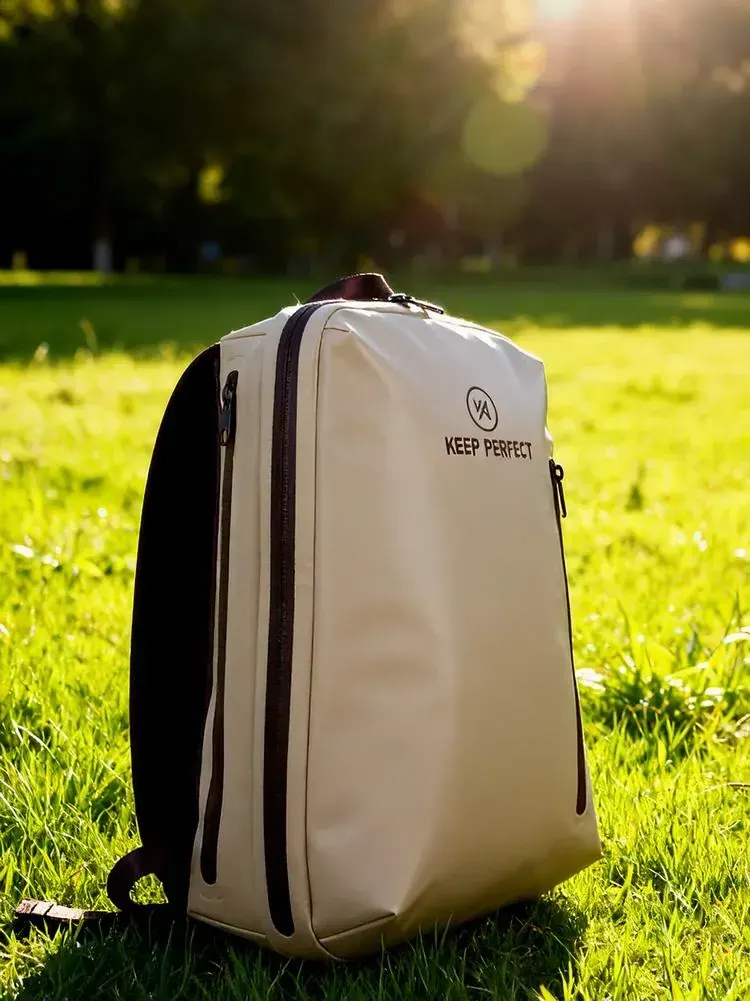
Every gram of waterproofing is a gram not spent on food or water, so hiking programmes are the most weight-sensitive category in the line. The penalty for genuine waterproof construction is real but manageable: TPU lamination adds 60-120 g over an uncoated shell, welded seam construction adds 40-90 g, sealed hardware adds 50-140 g, and a hip belt stiff enough to carry 12 kg adds another 80-150 g. In total a waterproof hiking pack runs 180-320 g heavier than a comparable uncoated pack.
| Hiking volume | Waterproof build weight | Uncoated equivalent | Penalty | Comfortable load | Trip profile |
|---|---|---|---|---|---|
| 18-22 L | 620-820 g | 430-600 g | 190-220 g | 4-6 kg | Fast day, trail running |
| 25-30 L | 850-1,050 g | 620-780 g | 230-270 g | 7-9 kg | Full day hiking |
| 35-40 L | 1.05-1.30 kg | 820-980 g | 240-320 g | 9-12 kg | Long day, alpine start |
| 45-50 L | 1.35-1.60 kg | 1.05-1.25 kg | 280-350 g | 12-15 kg | Two to three days |
| 55-65 L | 1.60-2.00 kg | 1.30-1.65 kg | 300-350 g | 15-20 kg | Multi-day, self-supported |
The saving worth chasing is not in the shell but in the harness. A moulded EVA hip belt with a 12 mm foam core carries 12 kg comfortably and can be trimmed to webbing plus 6 mm padding below 8 kg, which removes 120-180 g. Buyers sourcing a sub-500 g daypack programme should look at the lightweight waterproof daypack under 500 g brief, where the weight is taken out of the frame sheet and pocket count rather than the barrier film.
Shell, Seams and Back Panel: The Construction Choices That Matter
Hiking packs take abrasion from rock, granite and bush that a travel pack never sees, so the shell specification has to balance barrier performance against scuff resistance. The working compromise is 500D or 840D TPU-laminated fabric at 5,000-10,000 mm hydrostatic head, welded at the seams, with the abrasion zones reinforced rather than the whole shell thickened. A coating that beads water on day one and stops beading by month nine is normal; the barrier film underneath is what keeps the contents dry.
| Component | Hiking specification | Why it matters | Failure mode if skipped |
|---|---|---|---|
| Shell fabric | 500D-840D TPU laminate | Balances scuff resistance with 5,000-10,000 mm head | Abrasion holes at base panel |
| Seam method | RF welded, 27.12 MHz | Sealed without needle holes | Weeping along stitch lines |
| Back panel | 6-10 mm spacer mesh with airflow channels | Moves sweat away from the back | Saturated shirt under a sealed panel |
| Hip belt | 12 mm EVA core, 70-80 percent load transfer | Keeps 12 kg off the shoulders | Shoulder numbness after 4 hours |
| Base panel | Double-layer or 1000D reinforcement | Survives being set on wet rock | Puncture from sharp granite |
| Closure | Roll-top, 3 turns, 60-80 mm fold | Holds IPX5 without hardware cost | Two-level rating drop if rolled once |
Breathability is the trade every buyer asks about and few specifications address. A sealed shell cannot vent through the fabric, so sweat management has to come from a suspended back panel with 6-10 mm spacer mesh and vertical airflow channels. Expect a damp shirt on a steep climb regardless of the pack; the gain is that the contents stay dry, and the fix for the wearer is a wicking base layer rather than a vented shell. The physics are unpacked in breathability versus waterproof on a backpack.
Dry Bag or Waterproof Pack: Choosing the Sealing Strategy
Hikers run two sealing strategies and they are not interchangeable. A waterproof pack seals the outer shell, so the whole bag is the barrier and access is fast. A dry-bag system puts a sealed liner inside an ordinary pack, which costs 180-320 g, adds a packing step, but lets the same pack serve desert and rainforest trips. For expedition and paddle-supported hiking the liner wins; for day and weekend hiking the sealed shell is lighter in practice because there is nothing to forget at the trailhead.
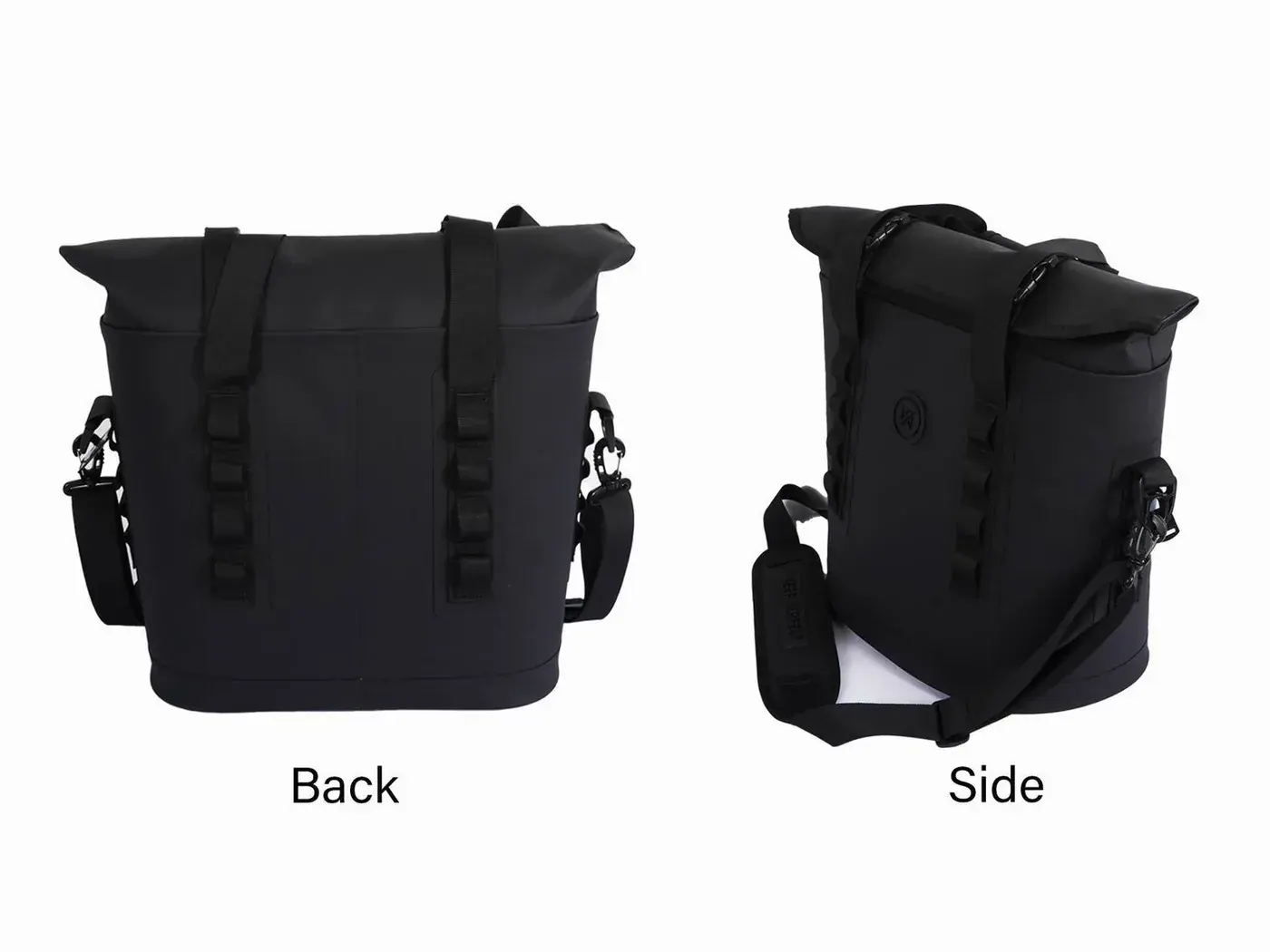
Where programmes need both, the hybrid is a welded inner compartment with a roll-down mouth separate from the main access. That keeps wet shells, muddy shoes and a soaked rope out of the sleeping system without forcing the wearer to unpack a liner at the end of a long day. The decision framework is laid out in waterproof backpack versus dry bag, and the wider category context sits in the waterproof backpack pillar guide.
Volume and Load: Sizing a Hiking Pack Honestly
Hiking volume claims are the least standardised numbers in the category, because some brands count external pockets and lid volume while others measure only the main body. A procurement spec should therefore fix the measurement method, then state the load in kilograms at which the harness remains comfortable. As a rule of thumb, a hiker carries 7-9 kg for a full day, 11-13 kg for two days with shelter, and 16-20 kg when carrying food for five days or more.
| Trip profile | Volume | Typical carried load | Harness requirement | Waterproof rating |
|---|---|---|---|---|
| Half-day loop | 18-25 L | 4-6 kg | Webbing belt, no frame | IPX4-IPX5 |
| Full-day ridge | 28-35 L | 7-9 kg | Padded belt, light frame sheet | IPX5 |
| Overnight hut trip | 35-45 L | 9-12 kg | Padded belt, load lifters | IPX5 |
| Two to three-day trek | 45-55 L | 12-15 kg | Moulded belt, alloy stay | IPX5-IPX6 |
| Five-day self-supported | 55-70 L | 16-20 kg | Full suspension, 20 kg rating | IPX6 plus liner |
Fit range is the dimension most often missed in a specification. Shoulder straps should adjust across at least 200 mm of torso length so one size covers a 165-185 cm wearer, and the sternum strap needs 80 mm of vertical travel to sit at collarbone height rather than throat height. A pack that fits a 178 cm test hiker perfectly will be returned by everyone outside a 6 cm torso band.
Winter and Shoulder Season: Where Sealed Shells Get Tested
Cold is harder on waterproof construction than rain. A TPU barrier film stays supple down to about -30 degrees Celsius, while PVC compounds begin to stiffen somewhere between -10 and -15 degrees Celsius and can crease-crack if the pack is folded while frozen. Wet snow at 0 to 2 degrees Celsius is the worst case, because meltwater finds every closure gap and then refreezes, so winter hiking builds should pair a welded body with glove-friendly hardware.
- Write the cold-flex target into the specification for Nordic, Canadian and alpine channels, where -20 degrees Celsius service is routine.
- Use oversized zip pullers and ladder-lock buckles that can be worked with a lined glove at -10 degrees Celsius.
- Avoid external mesh pockets in snow conditions: they collect wet snow, freeze solid and add 300-600 g.
- Plan for a hydration hose route inside the shoulder strap; an external hose freezes within 30-45 minutes below -5 degrees Celsius.
Pole and axe carry also changes in winter. Daisy chains rated for 5 kg per point and ice-axe loops with a shaft retainer are standard on 40 L and larger packs, and the loops must be welded or bar-tacked rather than stitched through the barrier film. Winter-specific builds are covered in winter waterproof hiking backpack and multi-day configurations in multi-day waterproof hiking backpack.
Trail Maintenance: Drying, Cleaning and Re-Treating
A sealed pack traps the water that gets inside, which is why the failure reported by hikers is rarely a leaking seam and almost always a damp interior that never dried. Drying discipline is therefore part of the product instruction: empty the pack, invert it, prop the mouth open and leave it in moving air for 12-24 hours. Storing a pack rolled shut while damp produces odour and mould in the foam within 48-72 hours.
| Task | Interval | Method | What to avoid |
|---|---|---|---|
| Fresh-water rinse | After every salt or muddy trip | Sponge and clean water under 40 degrees C | Machine washing, solvents |
| Full dry | Every trip | Mouth propped open, 12-24 h in moving air | Radiators, tumble dryers, direct sun |
| DWR refresh | When face fabric stops beading, 12-18 months | Spray-on, heat-set at low temperature | Wax-based treatments on TPU film |
| Seam inspection | Every 6 months | Visual check plus air-decay test | Ignoring cloudy film at weld edges |
| Hardware check | Every 6 months | Cycle every buckle and zip 20 times | Forcing a stiff airtight zip |
Verification before a season is cheap and takes 20 minutes: fill the pack with dry paper towel, seal it as the user would, and run a shower over every face for 10 minutes at about 10 L/min. Any damp patch on the paper means the closure was not rolled far enough or a weld has begun to lift, and both are fixable at that stage. The step-by-step version is in how to test a waterproof backpack at home, and coating chemistry is explained in DWR versus membrane waterproofing.
Sourcing Figures for a Hiking Programme
Hiking lines are the most seasonal category in the range, so ordering discipline matters more than unit price. Plan sampling 5-6 months ahead of the retail window: 6-10 working days for a first sample, 35-50 days for bulk, and 25-35 days on the water to northern Europe or the US west coast. MOQ is 500 pcs per design and colourway, and consolidating three colourways into a single 3,000 pc run typically moves the unit price index from 1.00 to about 0.86.
| Hiking style | Volume band | FOB Xiamen price band | MOQ | Sample time | Bulk time |
|---|---|---|---|---|---|
| Roll-top daypack | 25-30 L | USD 11.5-18.0 | 500 pcs | 6-8 working days | 35-42 days |
| Welded alpine pack | 35-45 L | USD 16.5-24.0 | 500 pcs | 7-9 working days | 38-45 days |
| Expedition pack | 55-70 L | USD 21.0-31.0 | 500 pcs | 8-10 working days | 40-50 days |
| Ultralight daypack | 18-22 L | USD 9.5-14.5 | 500 pcs | 6-8 working days | 35-40 days |
Materials are screened for REACH and California Prop 65 compliance on every hiking programme, and PFAS-free durable water repellent is available for EU-bound orders; the chemical background is summarised in the EPA PFAS pages. Ratings used in the specification come from IEC 60529 ingress protection ratings, and the wider brand walkthrough sits. Ranked hiking picks are collected in best waterproof backpacks, and closure detail in roll-top waterproof backpack.
People Also Ask
Do I still need a rain cover on a waterproof hiking backpack?
Usually not. A rain cover adds 180-260 g, flaps in wind above 40 km/h and leaves the harness and back panel wet anyway, whereas a welded or roll-top shell seals the whole bag. Keep a cover only for packs rated below IPX4 that use a coated shell with stitched seams.
Why is the inside of my waterproof hiking pack wet when the shell is dry?
Condensation and wet gear are the usual causes, not leakage. A sealed shell cannot vent, so sweat, a damp rain jacket or a leaking hydration bladder puts 50-150 ml of water inside over a day. Dry the pack open for 12-24 hours and carry wet items in a separate welded compartment.
What hydrostatic head is enough for hiking in the rain?
Specify 5,000 mm minimum on the shell fabric, measured by ISO 811 or AATCC 127, and 8,000-10,000 mm for expedition and winter lines. Below 3,000 mm the face fabric wets out under sustained moderate rain and the pack feels heavy and cold even if the contents stay dry.
Can a waterproof hiking pack carry a hydration bladder?
Yes, and it is standard practice. Look for an internal sleeve sized for 2-3 L and a hose port that routes either over the shoulder or through a welded grommet, because an unsealed port is the most common leak path on an otherwise welded pack.
How much weight does waterproof construction add to a hiking pack?
Plan on 180-320 g over an uncoated equivalent: lamination 60-120 g, welded seams 40-90 g, sealed hardware 50-140 g and a stiffer hip belt 80-150 g. On a 30 L daypack that moves the empty weight from about 650 g to about 880 g.
Should a hiking pack be IPX7 if I only walk in rain?
No. IPX7 costs roughly 60-100 percent more per unit because it requires an airtight zip or a fully welded mouth, and it adds 200-350 g. Rain exposure is a duration problem solved by IPX5 or IPX6; reserve IPX7 for river crossings, packrafting and paddle-supported trips.
Frequently Asked Questions
Q1. What IPX rating should a waterproof hiking backpack have?
IPX5 is the right default for three-season hiking and handles heavy rain above 7.6 mm per hour for hours at a time. Move to IPX6 only for expedition, winter or paddle-supported programmes where the pack is hosed down or dragged through meltwater, since the extra sealing hardware adds both cost and weight.
Q2. Is a roll-top closure better than a zip on a hiking pack?
For hiking, yes in most cases. A roll-top with three turns and a 60-80 mm fold reaches IPX5-IPX6, tolerates grit and mud, and cannot fail catastrophically, whereas a coated zip weeps once the teeth wear and an airtight zip is expensive and needs care. Zips earn their place on packs that are opened 30 times a day.
Q3. How heavy is a 30 L waterproof hiking backpack?
A genuine 30 L waterproof hiking build weighs 850-1,050 g empty with a padded hip belt, against 620-780 g for an uncoated equivalent of the same volume. Ultralight builds that drop the frame sheet and use a simple webbing belt come in at 620-820 g for 18-22 L.
Q4. Can I machine wash a waterproof hiking backpack?
No. Machine washing flexes welded seams against an agitator, strips durable water repellent and can delaminate the film at the weld edge in a single cycle. Rinse by hand with clean water under 40 degrees Celsius, use pH-neutral soap for mud or salt, and air dry with the mouth propped open.
Q5. Do waterproof hiking packs breathe?
Not through the shell. A sealed barrier cannot pass vapour, so ventilation has to come from a suspended back panel with 6-10 mm spacer mesh and vertical channels. Expect a damp shirt on steep climbs and manage it with a wicking base layer rather than expecting the pack to vent.
Q6. What volume do I need for a two-day hiking trip?
Plan 45-55 L for two to three days with shelter, cooking kit and food, at a carried load of 12-15 kg. If you are hiking hut-to-hut without a tent or stove, 35-40 L at 9-11 kg is usually enough, and the harness requirement drops accordingly.
Q7. Will a waterproof hiking pack keep a sleeping bag dry without a liner?
Yes if the pack is rated IPX5 or better and the closure is rolled correctly, because the shell is the barrier. Many hikers still use a 10-20 L liner as insurance on multi-day trips, since it also isolates a wet tent and muddy boots from the sleeping system.
Q8. How do I stop a waterproof hiking pack smelling musty?
Dry it properly every time. Empty the pack, invert it and leave the mouth propped open for 12-24 hours in moving air, because sealed shells trap the 50-150 ml of water that gets inside from sweat and wet gear. Mould begins to grow in foam within 48-72 hours if the pack is stored rolled shut.
Q9. Does cold weather damage waterproof hiking packs?
It can. Barrier film in TPU stays supple near -30 degrees Celsius, while PVC compounds harden around -10 to -15 degrees Celsius and can crack at a fold if the pack is frozen shut. Also route hydration hoses inside the shoulder strap, since an external hose freezes in 30-45 minutes below -5 degrees Celsius.
Q10. What is the MOQ on a waterproof hiking backpack order?
Orders open at 500 pcs for each design and colourway; sampling takes 6-10 working days and production 35-50 days, quoted FOB Xiamen. Combining three colourways into one 3,000 pc run usually lowers the unit price index from about 1.00 to 0.86.
Q11. How do I test a hiking pack for leaks before a trip?
Fill it with dry paper towel, close it exactly as you would on the trail, then run a shower over every face for 10 minutes at roughly 10 L per minute and check the paper. For a pack claiming IPX7, follow with a 15 minute dunk in a bath with 5 kg of weight inside.
Q12. Are external mesh pockets a problem on a waterproof hiking pack?
In rain they hold water and add 200-400 g, and in snow they collect wet snow that freezes into a 300-600 g block. Solid welded side pockets with drain holes are the better specification for three-season use, and expedition builds often drop external pockets entirely.
Q13. Can waterproof hiking packs be made PFAS-free?
Yes. PFAS-free durable water repellent on the face fabric matched with a TPU barrier film reaches the same hydrostatic head in laboratory testing and is the default for EU-bound programmes. Ask for it at quotation stage so the first sample is finished and tested with the right chemistry.
Q14. How long does a waterproof hiking backpack last?
Five to eight years of regular seasonal use is typical for a TPU-laminated welded pack stored dry and out of direct sun. The two failure drivers are hydrolysis from long-term damp storage and UV exposure, both of which accelerate sharply if the pack lives in a car boot or a boat locker.